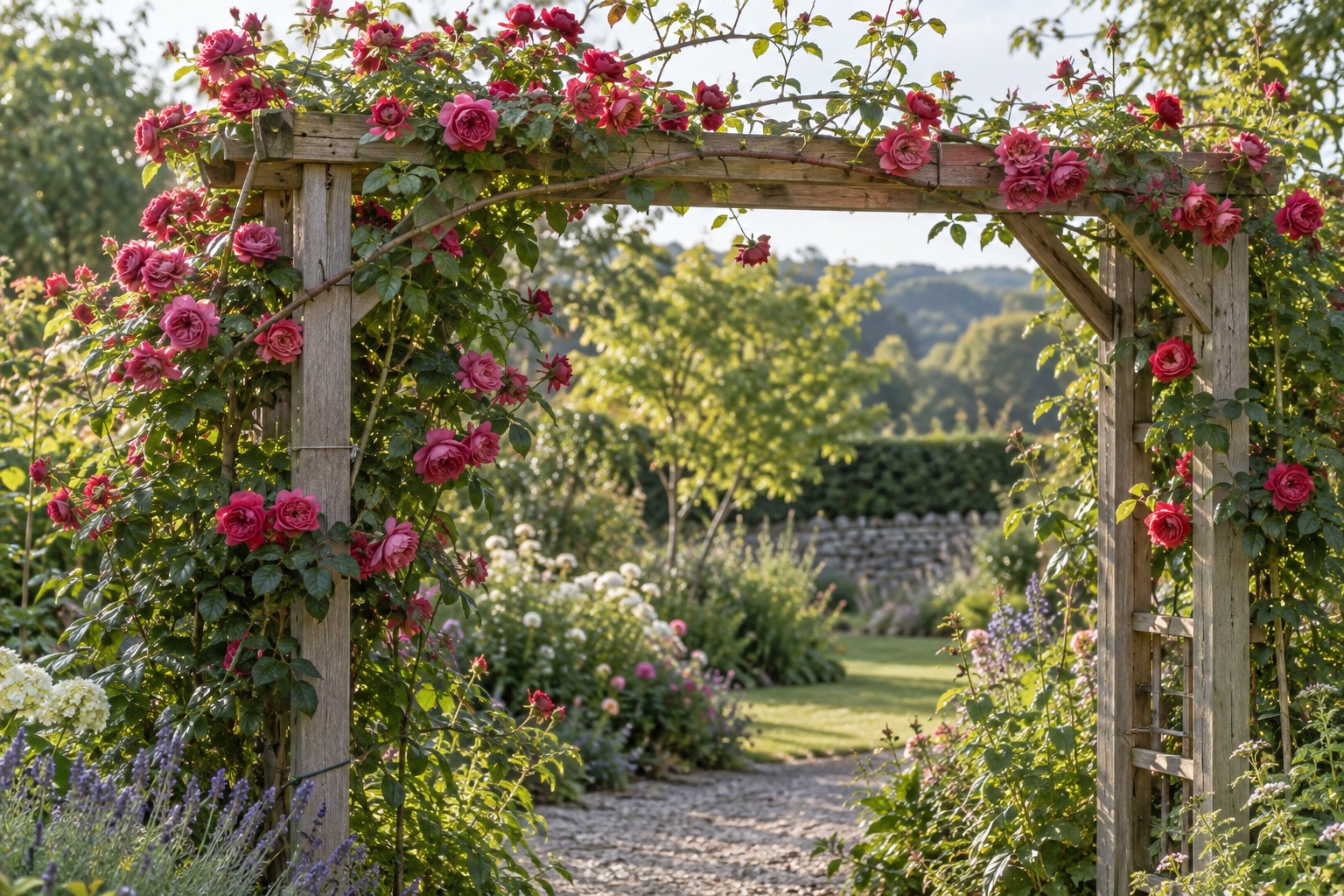
A climbing rose needs a place for its long canes and a gardener who can reach them. It will not wrap itself around a trellis like a twining vine. The practical choice is therefore a structure with usable tie points, enough space to arrange canes, and a route for you to return and adjust them. A narrow decorative tower may look promising in a product photo but be awkward once the rose occupies its sides.
Start with the rose's named variety and the place it will grow. We recommend planning the cane layout before buying an arch or panel, then choosing a support that keeps that layout reachable. UConn's climbing-rose guidance explains why tying and retraining matter.
Choose the shape of the rose before the shape of the metal
A rose described as “climbing” produces canes that can be guided over a support; the label does not mean the plant attaches itself. Identify the variety and its expected height and spread from a reliable plant source. Washington State University Extension's climbing-rose publication provides context for training and care, but the individual plant's habit still controls the layout.
Imagine a rose planted beside a long fence. You may have space to spread canes along it, with tie points at several heights. A narrow upright trellis in the same position concentrates the growth in one strip and can make pruning harder. At a garden entry, an arch can put flowers overhead, but only if the passage remains useful after stems and leaves fill the sides. Against a house wall, a panel may provide the right outline while raising a separate question about the wall and fasteners.
Draw a simple front view of the mature arrangement. Mark where the main canes could run and where you would stand to attach or loosen ties. Then make a top view showing paths, doors, windows and neighboring plants. This is more informative than comparing product height alone: a support has to carry the intended shape while preserving the space around it.
Be cautious with generic photographs of roses draped over elaborate arches. They show a possible visual effect, not proof that the exact arch accommodates your variety, installation conditions or maintenance routine. Check the current dimensions and assembly instructions for the particular product you might buy.
Give canes tie points you can reach again
UConn describes securing and revisiting climbing-rose canes rather than expecting the plant to climb unaided. Choose a support with places where a soft plant tie can hold a cane without forcing it across an inaccessible gap. A frame with a few widely spaced uprights may need an added trellis or wire system. That addition needs its own suitable attachment; do not assume twine strung between decorative parts will be durable or safe for your site.
When placing the support, leave access to both the plant base and the canes you plan to train. A panel pressed hard against a fence can hide the rear of the plant. An arch at the edge of a narrow path may allow you to tie its outside face but not its inside face after growth fills in. If you cannot reach a planned tie point with the plant in place, redesign the arrangement before purchase.
Ties are a continuing task. The cane changes as it grows, and the chosen route may need adjustment. Check ties during routine rose care so they do not constrict stems or pull against sharp edges. Follow the plant guidance for pruning the variety you have rather than cutting simply to make it fit a fixed silhouette. A good support makes those decisions possible without dismantling the garden.
| Form | What it does well | Tradeoff to plan for |
|---|---|---|
| Fence with correctly installed wires | Spreads canes across a long area and can use an existing boundary | Fence condition, fasteners and reach behind growth must be checked |
| Wall panel | Defines a vertical training area | Width may be limiting; wall mounting is a separate installation decision |
| Freestanding arch | Frames a route or entrance | Clear passage shrinks as the plant grows; both sides need maintenance access |
| Obelisk | Fits a compact open-bed arrangement | May crowd a vigorous rose and limit horizontal training |
Measure a route through an arch, not just its outer width
For an arch, measure the path people actually use. Note the width of a wheelbarrow or other item that regularly passes through, then allow for the canes and leaves that will occupy part of the opening. Maker listings often give outer installed dimensions. Those are valuable for laying out the structure, but they do not automatically equal clear walking width. Ask for or measure the inner opening of the exact assembled model.
Consider a path that looks generous on a winter plan. In summer, a rose may project inward at shoulder or arm height. That can be uncomfortable even if the ground-level gap remains clear. Put the planned tie route on the outer lattice where possible and leave a maintenance path to trim growth that moves into the opening. If the entrance must remain reliably wide, a flat fence arrangement may be a better solution than an arch.
Our rose arch comparison places two freestanding models beside a bed-connected system. The different forms matter more than a simple tallest-to-shortest ranking. A bed-connected arch also requires a verified match to the specific raised-bed system; it is not a universal freestanding arch.
Treat installation as part of the purchase
Find out what the maker expects beneath and beside the structure. A listed stake length tells you what is included; it does not certify the support for every soil, exposure or plant size. A wall panel's bracket count does not prove that your wall can carry the assembly. Read the current manual for the exact variant and ask for local installation advice where the surface or exposure is uncertain.
For an established rose, setting large stakes close to the crown can be more disruptive than installing the support before planting. Plan the sequence of work and protect existing roots when changing an older bed. An arch that looks easy to assemble on open ground can be harder to place around a rose that is already full of canes. Check whether the product is intended to be assembled in place and whether you can work safely around the plant.
For a rose against a wall, consider a freestanding support if the wall is unsuitable or if you want easier access behind the canes. Conversely, if the wall is sound and mounting is properly designed, a panel or wire system can keep a narrow path open. The plant's training method does not decide the structural question; they must both be solved.
Keep the product's dimensions in context. Height can be useful if it matches the rose and the space. Extra height adds no value if the upper tie points cannot be reached for training and pruning. A wider panel can be useful if it lets you spread canes, but it also needs a suitable mounting area.
Use a purchase checklist before committing to a form
- Confirm the exact rose variety and its expected size, then sketch the space it can occupy.
- Decide whether you want a wall display, a long fence, a garden focal point or an entrance. Do not ask one product to do all four jobs.
- Locate tie points for the main canes and check that you can reach them again after the plant fills out.
- For an arch, measure the required clear route, not only the listed outer width.
- For a wall or fence, identify its material and condition, then match fasteners to the maker's instructions and local conditions.
- For a freestanding structure, read the exact anchoring directions and leave room to maintain the plant on both sides.
If a suitable, sound fence is already in place, adding correctly installed training points may solve the problem without buying a new feature structure. If you want flowers framing a path, buy for the route and your ability to maintain it. A tall, narrow obelisk is a considered choice for a compact plant and open bed, not the default for every climbing rose.
Make the support serve the training plan
For most roses grown along a boundary, start with a broad, accessible arrangement that lets you guide canes and return to their ties. Choose an arch when it serves an actual passage and you can verify the clear opening and installation. Choose a wall panel when the desired area, mounting surface and maintenance access all fit. The strongest reason for any of these choices is a workable cane route, not a decorative label.
Before ordering, stand in the planting place and trace where your hands will go next season to tie, loosen and prune. If that route is blocked or the structure leaves no room for the plant to spread, change the design. For concrete outer dimensions and installation questions, read our rose arches and wall trellises comparisons.