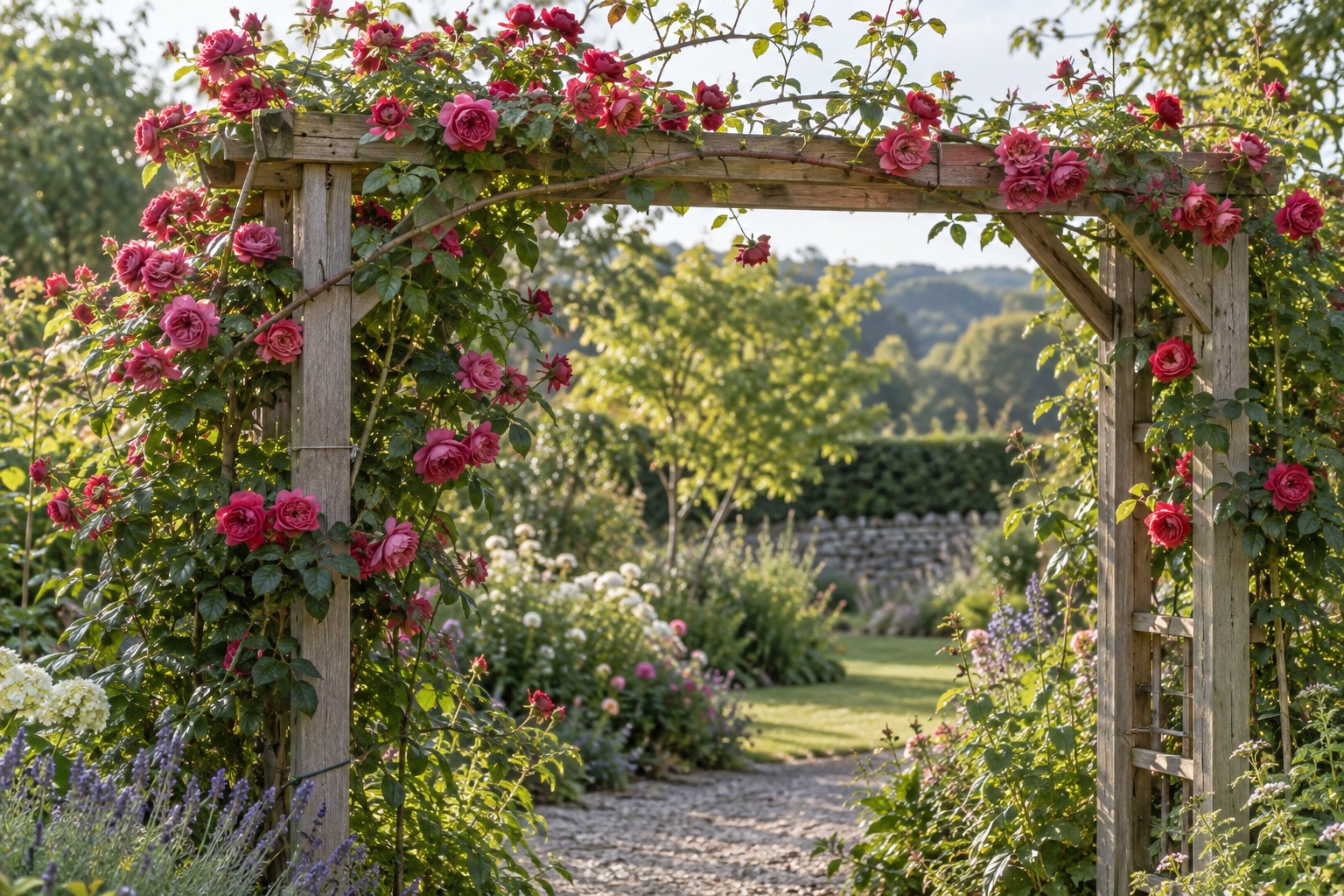
An arch for a climbing rose has to serve two users: the rose whose canes need training, and the person who must pass beneath and care for it. The widest number on a product listing is usually an outside dimension, not a promise of clear walking space. Start with the actual path and a plan for tying canes, then compare arches. If the path cannot stay comfortable as the plant grows, a fence or wall support may be the better choice.
This page compares Gardener's Supply Jardin and Modena freestanding arches with Vego's raised-bed-connected arch. UConn's rose guidance explains why the canes need guiding and later adjustment. The dimensions and assembly details come from maker information checked September 27, 2026.
Separate outside size from usable passage
Measure what needs to pass under the proposed arch: people, a wheelbarrow, a mower, or nothing more than a garden view. Then allow room for foliage and canes at the sides. A maker's outer width tells you how much ground the assembled frame may occupy. The actual clear opening can be smaller because of uprights, lattice and plant growth. Ask for the inner dimensions of the exact product if the passage matters.
Swipe across the table to see every decision question.
| Product | Maker-listed configuration | Potential fit | Open check |
|---|---|---|---|
| Jardin Rose Arch | 54 in wide × 22 in deep × 96 in high installed; open 4 in lattice; powder-coated tubular steel. | A narrower freestanding outer width and visible tie-point pattern. | Clear passage, site anchoring, rose size and tie access. |
| Modena Arch | 65 in wide × 20 in deep × 90 in high installed; four 8 in ground stakes listed. | A wider listed outer footprint when the site has room. | Inner opening, stake method for the actual soil and usable tie route. |
| Vego Garden Arched Trellis | Modular arch for compatible Vego beds; maker describes a 4.5 ft span and multiple bed-length variants. | An integrated option where matching raised beds are already part of the plan. | Exact bed sizes, spacing, connectors, arch variant and plant arrangement. |
See the Jardin profile for its assembly sheet and a closer look at how to apply the published size. The dimensions above do not establish load, wind performance or accessibility compliance.
Map the rose's canes to reachable tie points
A climbing rose does not wind itself around an arch. Its canes need to be directed and secured, then checked as they grow. Washington State University Extension adds broader climbing-rose care context. Before buying, sketch where the main canes could run from the planting spots onto the upright sides and over the top.
Jardin's listed four-inch open lattice gives a visible pattern of possible tie points. That is useful to investigate, but the plant's exact size and your reach still matter. Can you tie a cane on the outer side without standing in the middle of the path? Can you later loosen and replace the tie without pulling the plant through the opening? A very tall crown may look beautiful but be difficult to maintain from the ground.
Modena's listing gives a wider outside dimension. That may create more room for a broad entrance, though the actual inner gap has to be confirmed. The rose will still need a route along the uprights and overhead. Do not assume a product with a wider footprint automatically spreads canes better; inspect the pattern and where the plant will be rooted.
Vego's system changes the question. It is designed to connect to compatible raised beds. If you already use those beds, the integration may create a planned growing corridor. If you do not, the arch cannot be evaluated as though it were a standalone frame. Match the exact bed type, length, spacing and connector instructions before asking whether it suits your rose.
Protect the usefulness of the path
Imagine a daily route to a shed. The outside width of an arch might look generous on paper, yet growth at shoulder height can make the route unpleasant. Mark the walking line and the space needed to carry typical items. If you need to preserve a wide, predictable route, consider whether an arch is the right form at all. A rose trained along a fence may be more useful than an arch that repeatedly needs pruning to stay passable.
At a decorative path used only occasionally, a narrower frame may be entirely reasonable, provided you can enter to maintain it. In a productive garden, the passage may need to accommodate tools and carts. The choice between Jardin and Modena then depends on the verified inner opening and the room outside the frame for the plants, not the exterior width alone.
Think about the plants at the base. One rose on one side and two roses flanking an arch are different designs. Do not assume a photograph with lush coverage tells you the number, variety, time or training required. Check the named rose's expected spread and put its roots where the maker's installation and plant-care guidance allow. Leave a place for routine weeding, watering and pruning.
UConn describes guiding main rose canes and checking soft ties as growth changes. On an arch, that means the first neat arrangement is only the start: decide where a cane can go when it reaches the upper curve and how you will reach that point again. If the top is beyond your practical working height, a lower wall or fence arrangement may be easier to manage even when the arch physically fits the path.
Check installation before treating an arch as permanent
Jardin's assembly sheet shows lower panels with stakes. Modena lists four eight-inch stakes. Those facts describe parts of the two products; they do not tell us how either behaves in your soil, wind or with a mature rose. Read the exact current instructions and assess the site. If the conditions are unusual or unclear, seek local installation advice.
An arch in a soft bed, one crossing paving and one placed between raised beds have distinct anchoring questions. Do not assume you can substitute another fastener for the maker's method without understanding the structure. If the arch is going over an established rose, think through the assembly sequence and the existing roots and canes before purchase.
Product weight, material and finish are not a substitute for a supported load rating. We have no independent measure of how any arch here will perform after years outdoors. The honest comparison can still be useful: it tells you which form, dimensions and compatibility facts are published, and which critical questions must be answered for your site.
Also inspect how the path drains and how the ground is maintained. If the base would stand where soil is frequently disturbed for edging or replanting, the installation needs extra planning. If paving covers the intended base points, ordinary ground stakes may not be the applicable method. Change the arch position or seek a documented installation approach for that surface rather than improvising a connection because the frame happens to fit overhead.
Keep the assembly instructions with your path measurements so the eventual placement follows the model you actually choose.
Choose by the job, then by the model
Investigate Jardin first for a narrower freestanding location. Its listed 54-inch outer width and four-inch lattice make it a concrete candidate when you want a modest garden entrance and reachable tie points. The drawback is that the actual inner route and rose growth still need checking. It is not a recommendation to squeeze an arch into a path that needs more width.
Investigate Modena when the garden can accommodate a wider freestanding exterior. Its 65-inch listed outside width may be useful, but measure the clear passage before choosing it for a functional route. Its included stakes do not settle your soil or exposure. A wider product is a layout option, not evidence of greater strength.
Investigate Vego only with a compatible raised-bed plan. It may make sense when matching Vego beds are already selected and the desired planting arrangement spans them. Its bed connection is a fundamental requirement, not an accessory detail. If you want a simple arch over ordinary ground, compare the freestanding forms instead.
- Confirm the rose variety, expected size and a reachable cane-training route.
- Measure the passage you need and request the exact clear opening, not only the outer width.
- Place roots, uprights and maintenance access on one plan.
- Read the current assembly and anchoring instructions for the exact model and site.
- Choose a fence or wall arrangement if an arch would make the path or upkeep awkward.
Our recommendation is to decide whether an arch improves the garden's route before choosing one. Jardin is a narrower freestanding candidate, Modena a wider one, and Vego a separate raised-bed system. None has a verified fit for a specific rose or site here. Read the climbing-rose guide for the training plan that should precede the purchase.
Sources used
- UConn — tying climbing roses
- Washington State University Extension — climbing roses
- The three linked maker listings and Jardin assembly sheet, checked September 27, 2026.