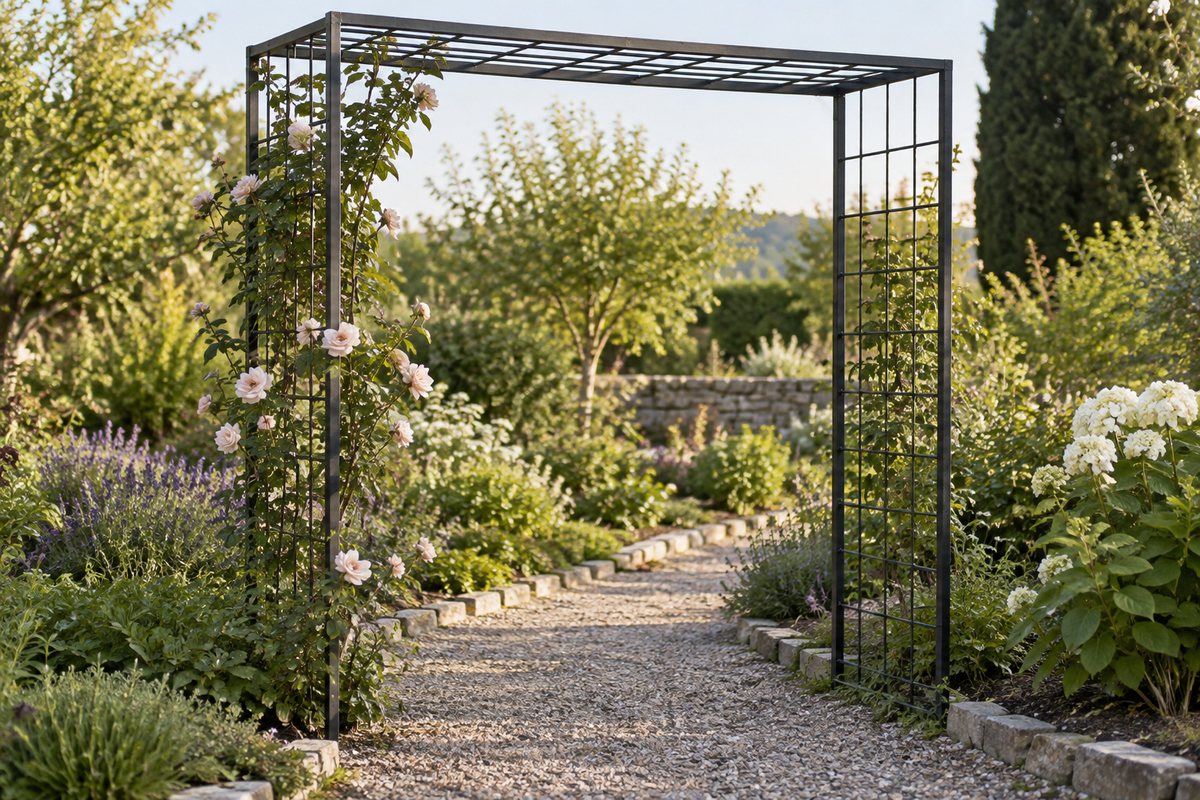
Gardener's Supply's Modena Arch, SKU 13462, is a flat-topped, freestanding passage rather than a narrow plant tower. The maker lists an installed outer size of 65 inches wide, 20 inches deep and 90 inches high, four eight-inch ground stakes and a 45-pound product weight. Those measurements make it worth investigating for a garden entrance where climbing rose canes can be tied over the top. They do not state the clear walking opening or establish how it will hold in your soil.
Our verdict is to shortlist the Modena when you have a measured passage, room to train canes from both sides, and a site where the maker's anchoring method can be assessed. The broad outer width and a real assembly PDF are useful. The main limitation is the gap between outer dimensions and usable, safely installed passage. The linked Amazon listing matches the reviewed Modena model by maker, name and dimensions.
Measure a passage, not a catalog silhouette
The 65-inch width is the outside installed measurement. It is not a promise that 65 inches remain clear for a person, wheelbarrow or mower between the legs. The 20-inch depth is also an outside dimension of the frame, not a calculation of clear path length. Mark the maker's rectangle on the ground, then measure the actual route that must stay open. Leave space for the frame, rose canes, thorns, ties and the reach needed to maintain them.
A gardener creating a path between two beds should measure the narrowest needed clearance first. Then position the plant locations where canes can be guided toward the two sides without crossing the walking route at face height. A second gardener framing a view but rarely walking under the arch may give more priority to the broad top. A third trying to cover a narrow gate may find the 65-inch outer width simply too large. Those are different decisions; an attractive arch photo cannot replace a tape measure.
The installed height is 90 inches. That gives a useful height marker for the frame, but rose growth and training can reduce practical overhead clearance. Make the check at the time of pruning as well as at first installation. A structure that is accessible when bare may become awkward once long canes are secured across the top.
Use the assembly instructions before choosing the site
The February 2026 Modena assembly sheet lists a top panel, two top side panels, two upper side panels, two bottom side panels, four stakes and four screws. It says assembly is best with two people, on a flat clean surface, and describes tipping the assembled arch upright. This matters if the intended spot is already crowded with mature plants. You need room to assemble and raise it without dragging the frame through canes.
The manual's sequence starts with joining top pieces, then upper and bottom side panels, and finally placing the stakes. Read the current PDF before purchase and check that every listed part is in the exact package. The maker recommends setting stakes in concrete for added security in sand or other loose soil. That is a conditional instruction, not evidence that eight-inch stakes alone fit every site. We cannot certify soil bearing, wind resistance or a loaded rose's long-term safety from the listing.
If the path is a paved patio with no suitable ground at the legs, the supplied stake method does not answer installation. Do not assume a pot, deck plate or different anchor is interchangeable with the manufacturer method. A freestanding arch that has no credible anchoring plan is a poor purchase even if the outer dimensions fit perfectly.
Train a rose across the frame deliberately
UConn Extension explains that climbing roses need canes tied and guided rather than gripping a structure on their own. The Modena's side and top pieces may offer places to route and secure canes, but the maker does not supply a verified maximum cane size or an exact tie-point map. Inspect the current photos and assembled joints for places where a soft tie can hold a cane without rubbing against an edge.
A rose planted on one side needs a reachable path up that side and across the top. If you intend to plant on both sides, plan separate access for pruning and fastening ties. Keep the center of the passage clear. Washington State University Extension discusses training climbing rose canes to encourage flowering laterals. The practical implication here is that you may need to guide long canes across the broad upper area rather than simply allowing vertical growth to collect at one leg.
| Decision | Published fact | Your site check |
|---|---|---|
| Path fit | 65 × 20 × 90 in installed outer size | Measure clear passage after legs, canes and ties |
| Assembly | Manual calls for two people and flat assembly area | Allow space to lay out and tip the frame upright |
| Ground security | Four 8 in stakes; concrete advised in loose soil | Assess actual soil and follow the current instructions |
| Rose training | Flat top and side frame | Inspect accessible tie positions and future pruning reach |
Weigh its advantages and real limits
The flat top creates a different visual and training shape from a curved arbor. Its broad outside width could give rose canes a long horizontal route once they reach the top. The maker's powder-coated steel and published parts list let you inspect construction more concretely than a listing with only a lifestyle image. Those are reasons to investigate it, not a durability promise. We have no independent measurement of coating life, joint movement or maximum supported growth.
The product's 45-pound listed weight means bringing the box and raising the frame deserve planning, especially when the manual recommends two people. Weight by itself is not a stability rating. Stakes and soil do the installation work; a heavier frame can still be inappropriate in a poorly matched location. Check delivery access and the assembly area before deciding where the arch will stand.
A gardener with a narrow path or difficult soil should compare another form early. A wall panel can train a rose across a surface without spanning a passage, but then wall structure and fixings become essential. A raised-bed-connected arch may fit an owner who already has the matching bed system. Each alternative solves a different installation problem.
Compare the Jardin Rose Arch
Our Jardin Rose Arch profile covers a maker-listed 54-inch outer width, 22-inch depth and 96-inch installed height with a four-inch lattice. It is narrower and taller on paper. That does not make it the better arch: the useful question is your measured opening, the cane-training surface and the exact anchoring method. The arch comparison helps put those tradeoffs beside one another.
For a rose already growing near a fence, a stand-alone arch can add unnecessary installation work. If the existing boundary can be assessed and made suitable for ties, using it might deliver more continuous cane coverage. Buy the Modena because a freestanding passage and its dimensions serve the actual garden plan, not because a rose needs an arch by definition.
Our buying verdict
Shortlist SKU 13462 when a wide, flat-topped entrance is the desired structure, you can work with the two-person assembly sequence, and you have a credible plan for the four stakes in your soil. Its strongest supported advantage is its generous published outer span with a specific assembly document. The limiting questions are clear walking width and real site anchoring. Measure both before purchase, and keep future pruning access in the plan.
Choose a different frame if your path is narrower, the ground cannot accept the specified installation, or you only need a wall display. Recheck the maker's current listing and manual for this exact SKU. The linked Amazon item matches the reviewed model; check the selected item and current terms before ordering.