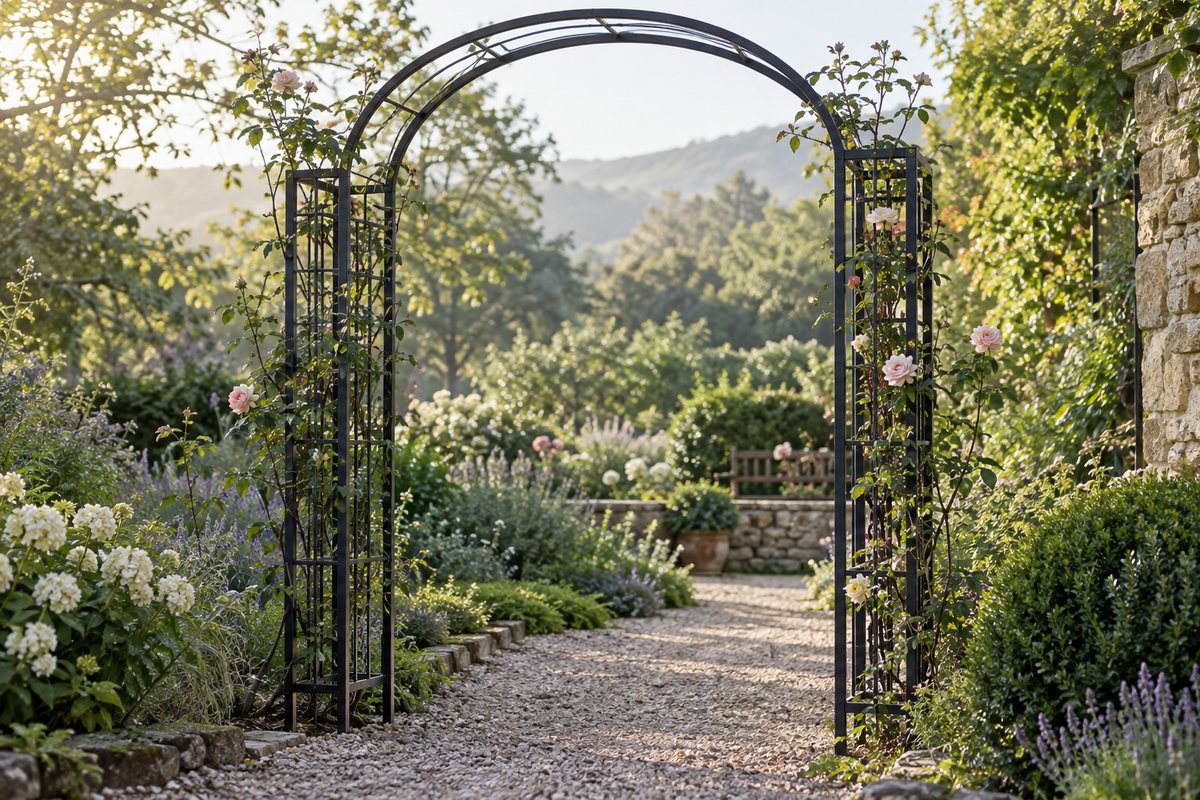
The Jardin Rose Arch is a freestanding frame with a published installed outer size of 54 inches wide, 22 inches deep and 96 inches high. Its open four-inch lattice gives a visible pattern where a climbing rose's canes might be tied. Those are useful starting facts, but they do not tell you how much clear walking space remains inside the arch or whether its ground installation suits your site. We recommend investigating it when a narrower garden passage is genuinely useful and the rose can be tended from both sides.
This profile covers Gardener's Supply SKU 12760, using its maker listing and assembly sheet reviewed September 27, 2026.
Begin with the passage you need
Place the published outside rectangle on a garden plan. Fifty-four inches is the overall listed width, not a verified inner opening. The uprights take space, and the rose will occupy more as it grows. Measure the route used by people and equipment, then ask for the actual clear opening of the assembled arch. If the route must carry a wheelbarrow or be comfortable every day, a small difference in inner width can matter more than the frame's decorative detail.
Consider a path to a shed. A rose can be tied along the outer lattice, but canes may grow toward the interior between visits. If the usable route needs to remain reliably wide, draw the plant's likely boundary on both sides and plan how you will keep it there. A product photo of a flowering arch shows an effect, not a measured passage after growth.
At an occasional path between garden beds, the arch can be a focal point. Its listed height provides overhead structure, but the upper area may be difficult to reach for tying and pruning. Stand where you would work and ask whether you can safely tend the important points without treating a very tall frame as maintenance-free.
Map a rose's canes to the four-inch lattice
UConn's climbing-rose guidance explains that rose canes need guidance and ties; they do not wind themselves around an arch. Jardin's open lattice gives a plausible set of attachment points to investigate. The useful question is where the main canes from your named rose will travel, not simply whether the arch has an ornamental grid.
Draw a route from each planting position up an upright and across the curve. Where can you tie without bending a cane sharply around an inaccessible part? Can you return later to loosen or adjust those ties? A rose planted on one side may create an asymmetrical display; two plants can change both appearance and the work required. Do not assume the listing's photos represent your variety, plant count or training time.
The four-inch lattice pattern is a product dimension, not a load or suitability rating for a particular rose. Check the exact cultivar's expected size and the space at the base. A vigorous plant may require more room to spread than the arch offers; a smaller plant may take time to occupy the frame. Washington State University Extension gives broader care context, while the specific plant label should drive the scale decision.
| Detail | What it helps you plan | What it does not prove |
|---|---|---|
| 54 × 22 × 96 in installed outer size | Footprint and visible frame | Clear inner passage or plant clearance |
| Four-inch open lattice | Possible tie-point pattern | Fit for every rose or long-term cane load |
| Powder-coated tubular steel | Listed construction | Weather life or structural performance at your site |
| Lower panels with stakes in manual | Assembly and ground-placement sequence | Anchoring suitability for every soil and exposure |
Check installation before planting
The maker's assembly sheet shows lower panels with stakes. Read the current instructions for the exact SKU and decide whether the arch can be installed where planned. A garden bed, a paved edge and a location between raised beds present different installation conditions. The presence of stakes does not establish wind resistance or suitability for soft soil.
If roses are already planted, think through how the frame will be assembled around them and where ground parts will enter the soil. Protect existing roots and canes during any change. Installing the structure before planting may be easier than trying to fit it over a mature rose, but the sequence should follow the maker's instructions and the actual garden conditions.
Leave room outside both uprights for you to work. If a dense shrub or fence presses directly against one side, that side's ties may become unreachable. A narrower listed footprint can be an advantage in a compact garden only when it still leaves an accessible working area and a useful route beneath it.
Compare the alternative forms honestly
The arch comparison includes Modena, whose listed outer width is wider, and a Vego system designed for compatible raised beds. If your path needs more room, investigate the clear inner opening of Modena rather than assuming the extra listed exterior width becomes walking space. If you already use matching raised beds, a bed-connected design deserves its own compatibility check.
If you mainly want a rose along a boundary, a fence or wall support may be simpler than an arch. It can let you spread canes without creating a passage that needs constant clearance. If you want flowers over an entrance and can maintain both sides, Jardin has a clearer job. Choose the form that solves the garden layout, not the one with the most appealing photograph.
Do not use the product's published finish or weight as a substitute for a tested capacity. The published material does not establish wind or mature-plant capacity. If the site raises questions beyond the current assembly instructions, get local installation advice before committing to a freestanding arch.
Decide with the path and rose on one drawing
- Measure the actual route and obtain the assembled inner opening if passage width matters.
- Confirm the named rose's expected size and sketch cane routes on both sides.
- Mark tie points you can reach again after the plant fills out.
- Read the current assembly sheet and assess the ground conditions at both bases.
- Keep maintenance access outside the arch and a clear route underneath.
- Use a fence or wall layout if the arch would make the path or care awkward.
We recommend investigating Jardin for a defined, relatively narrow garden entrance where its lattice and dimensions fit a real cane-training plan. Its advantage is the visible tie-point pattern and published installed size. Its main unresolved fit questions are the clear passage and site-specific anchoring. Resolve those before buying it for a rose.