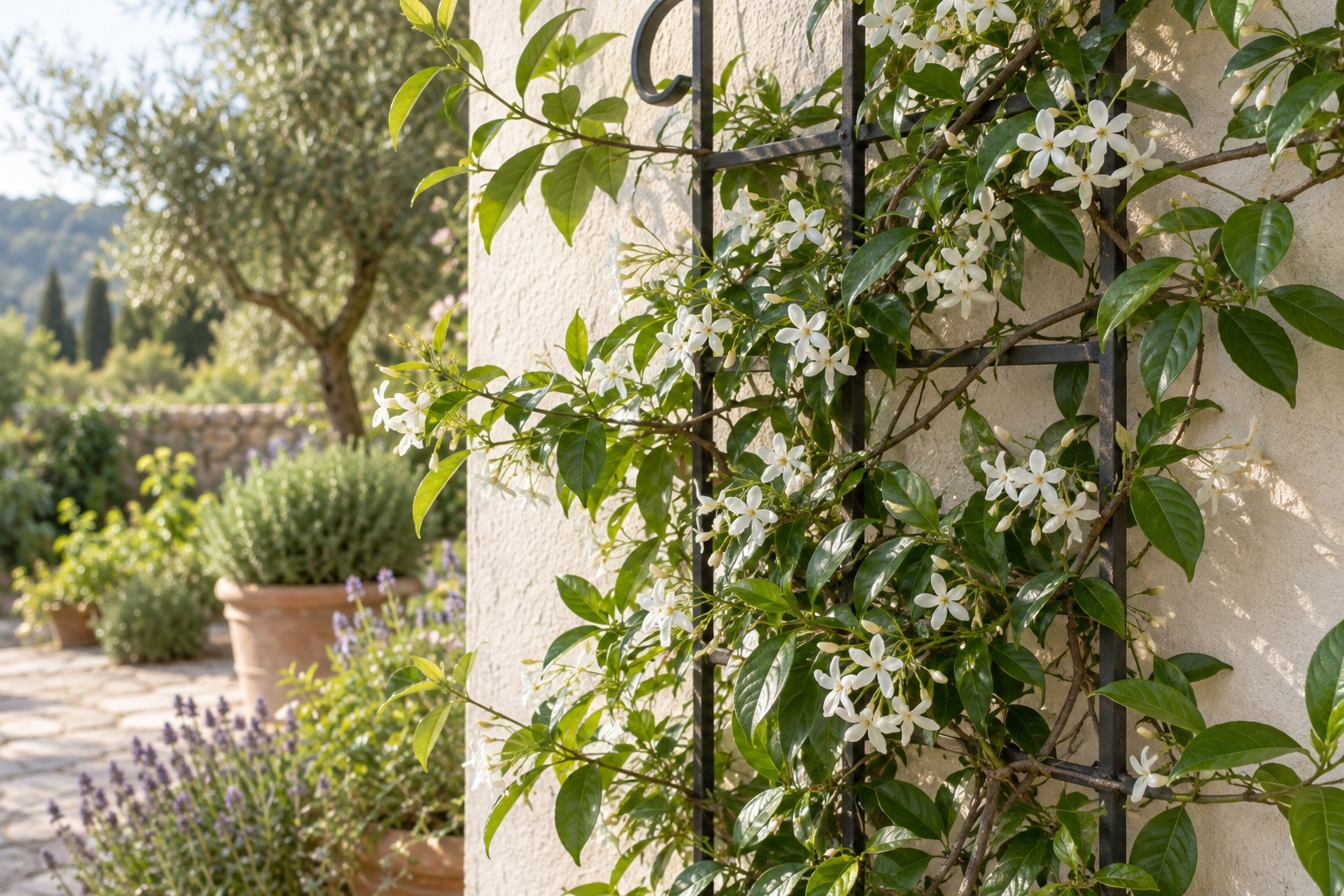
A wall trellis is easy to shop for by height and decorative pattern. In a real garden, the more useful questions are how much wall it covers, where the plant can attach or be tied, whether you can reach it for care, and how the panel will be fixed to the actual surface. This comparison looks at four maker listings through those questions. We recommend measuring the desired plant area and identifying the wall before choosing a panel.
The plant matters too. NC State Extension describes star jasmine as twining; UConn explains that climbing-rose canes need to be tied and revisited. The same trellis shape can give these plants different kinds of help.
Compare coverage and hardware together
Exeter's large panel is wider and shorter than the three tall, narrow options. That is a meaningful layout difference. A gardener hoping to spread rose canes across a broad wall might prefer width; someone filling a narrow strip between a door and corner may need a tall, slim panel. Neither dimension is automatically better. Draw the coverage area and keep access for pruning before applying product measurements.
Swipe across the table to see every installation question.
| Product | Published panel information | Where it may fit | What is still open |
|---|---|---|---|
| Exeter Wall Trellis | Small 18 × 42 in; large 34 × 42 in; powder-coated steel. | Large version offers a broader, lower panel. | Wall-specific screws and anchors; actual surface and bracket stand-off. |
| Essex Wall Trellis | 18 in wide × 70 in high; four wall brackets; mounting hardware omitted. | Tall, narrow area. | Fasteners and usable member geometry for the plant. |
| Modena Wall Trellis | 20 in wide × 72 in high; three wall brackets; screws omitted. | Another tall, narrow arrangement with a slightly wider listed panel. | Substrate, fasteners and access behind growth. |
| H Potter Heritage Scroll GAR124W1 | 19 in wide × 67 in high; adjustable 4–6 in brackets described with bolts for solid wood. | A published deeper bracket arrangement where solid-wood fixing is relevant. | Other wall materials and actual fixing suitability. |
Exeter's large-model profile examines its assembly sheet in more detail. The table compares published information, not tested capacity, installation safety or plant success.
Start with the plant's route across the panel
For star jasmine, trace where a twining stem can wind from the soil to the top and sides. A panel's outer rectangle can be large while its usable members are sparse. Decorative scrolls may give many directions, but ask whether the exact spacing lets you guide the plant through the desired area. A vine that quickly reaches the top of a narrow panel may need a wider route or regular edge management.
For a climbing rose, draw where the main canes would go and where you would put and revisit ties. A tall, narrow product may let you guide canes upward but provide less room to spread them sideways. A wider Exeter panel can create more horizontal area within a lower height, but its 34-inch width is still a defined panel, not an entire wall. If the rose's intended display exceeds it, multiple correctly installed supports or a different system may be needed.
For clematis, neither a pretty outline nor panel size alone establishes useful graspable parts. Vining clematis uses leaf petioles that benefit from narrow members. Inspect the actual bars or add an appropriate narrow layer if the maker permits it. Do not generalize a plant source into approval for one of these panels.
In all cases, put the plant base on the sketch. A panel mounted high above the soil may leave the first shoots without a route. If it is placed behind a deep border, you may not be able to reach its middle later. A few minutes tracing the plant and your hand access can rule out an awkward choice before any hardware is purchased.
Match the panel shape to the wall's job
Imagine a narrow wall section beside a gate. Essex, Modena or GAR124W1 may fit within the available width, while the large Exeter could project too far. Now imagine a low wall bay beneath a window: the wide, shorter Exeter may be a more logical form, provided growth is kept away from the window. A long blank wall needing broad coverage may be poorly served by any single narrow panel.
Measure around features that need access: windows, vents, downspouts, outlets, gates and service panels. A trellis can make a bare wall more useful to a climber while making maintenance harder if placed over those features. Leave a working route for future pruning and for inspecting the wall. The final planting width will exceed the frame's width if growth is allowed to spread; plan that boundary deliberately.
Check whether the panel should stand off from the wall for access and growth. H Potter publishes adjustable 4–6-inch brackets for its named model. The other listings describe brackets or panel depth, but those details alone do not establish the final clearance after installation. Ask for the current instructions. Do not assume two products with similar panels create the same working space behind them.
Use cardboard or painter's tape to outline the candidate panel on the wall before committing. This makes the broad, lower Exeter shape visibly different from the narrow vertical forms and exposes any conflict with a downspout or opening. Then stand at the distance you would use for pruning. A panel can be correctly dimensioned and still put the upper or far edge beyond comfortable reach once a plant fills it.
Resolve the mounting surface before ordering
Exeter's installation sheet leaves screws and anchors out because the appropriate choice depends on the wall; it specifies bracket placement for the large version. Essex and Modena likewise omit mounting hardware in their listings. That is not a minor missing accessory. It means you need to know the substrate and choose fasteners suited to it.
H Potter's GAR124W1 listing describes bolts for solid wood. If your surface is masonry, siding over framing or another material, the solid-wood instruction does not automatically transfer. The condition and construction of an existing fence also matter. If you cannot identify a sound fixing point, consult a qualified local installer or choose a freestanding design with a separately verified installation.
A bracket count is not a load rating. Four brackets do not prove Essex suits a larger vine better than Modena with three. Material, finish and product weight do not establish that either can carry a particular mature plant in wind. The product page should supply the correct assembly method; a local assessment handles the surface. Both are needed for a responsible choice.
Make a small installation inventory before purchase: panel, brackets, maker instructions, appropriate fasteners, tools and a plan for reaching the proposed fixing points. Essex and Modena omit screws, and Exeter's manual leaves anchors to the wall decision. That inventory exposes a hidden task that a side-by-side dimension table cannot show. If the wall cannot accept the required layout, select another form while it is still easy to change the plan.
Use a clear choice for three common situations
For a wider, lower training area, investigate Exeter large first. Its 34-by-42-inch listed panel offers a different shape from the narrow alternatives, and its manual gives useful bracket spacing detail. It is a candidate when the wall area, plant route and mounting method fit. The drawback is that it may be too short for the vertical display you want, or too wide for a constrained bay.
For a tall, slim wall bay, compare Essex and Modena. Essex lists 18 by 70 inches and four brackets; Modena lists 20 by 72 inches and three. These small numeric differences may matter when a gate or window defines the available space, but the choice still depends on usable bars, the plant and wall installation. Do not treat one extra bracket or two inches of height as proof of superiority.
For a design needing more published stand-off information, investigate GAR124W1. Its adjustable bracket description is more specific than a generic panel-depth figure, though it is framed around solid-wood fixing. Its scroll design may appeal visually, but the installation and plant route should decide its practical fit. A shopper with a different wall material still has work to do.
- Identify the plant and whether it twines, grasps or needs tying.
- Measure the desired coverage and every feature that must remain accessible.
- Trace the plant's route and the gardener's reach across the exact panel.
- Read the current model instructions, identify the wall material and select appropriate fasteners.
- Choose a freestanding alternative if the wall cannot be assessed or maintained suitably.
Our recommendation is to buy by coverage and mounting plan, then by appearance. Exeter large is the broad-panel candidate; Essex and Modena are narrow vertical candidates; GAR124W1 has the most explicit bracket stand-off in this set. None is a verified installation for your wall or a tested plant support. Read the star-jasmine or climbing-rose guide to decide which climbing surface you need.
Sources used
- NC State Extension — star jasmine
- UConn — tying climbing roses
- The four linked maker listings and Exeter installation sheet, checked September 27, 2026.