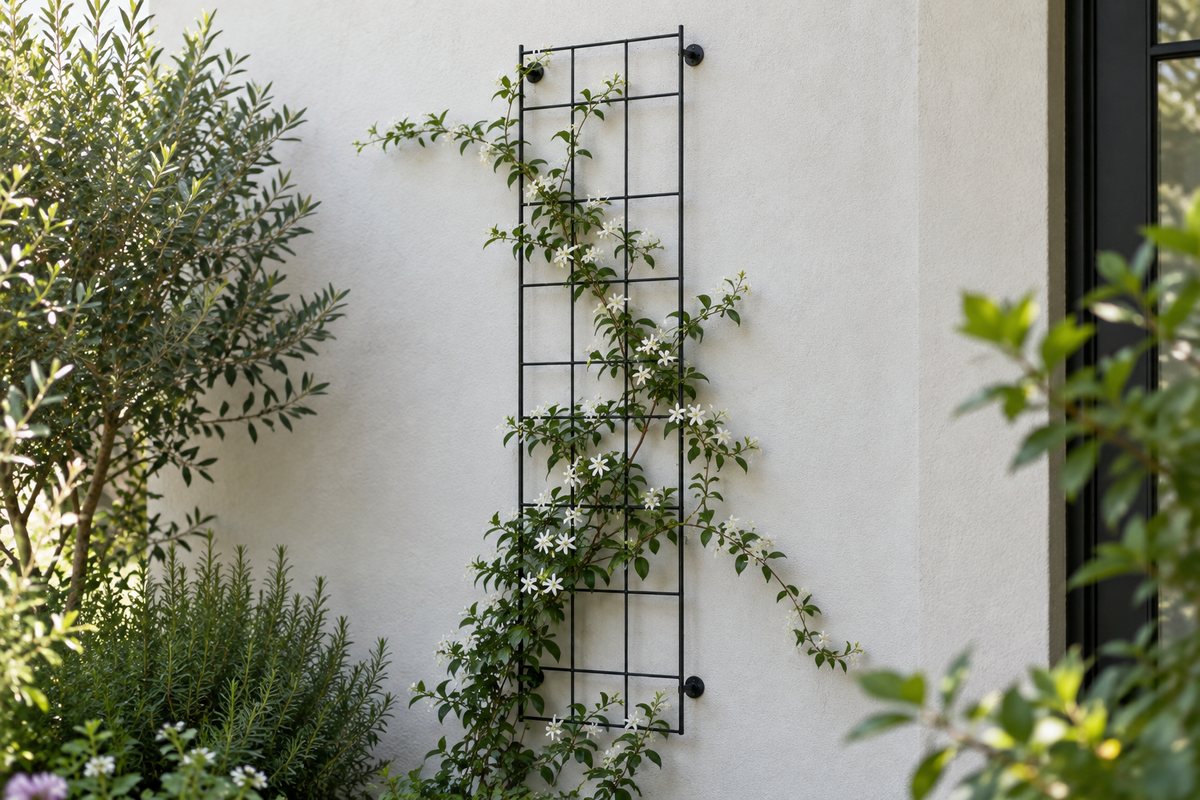
A tall, narrow wall panel solves a different problem from a broad garden screen. Gardener's Supply lists the Essex Wall Trellis, SKU 12740, at 18 inches wide, 2 inches deep and 70 inches high. Its four brackets come with the panel, but wall-specific mounting hardware does not. That makes it a plausible candidate for a slim strip of sound wall where a vine needs a defined route. The wall itself is the first buying question.
We would shortlist this model for a narrow architectural accent when you can verify the substrate, appropriate fixings and the plant's growth habit. Its main supported benefit is a specified tall, slim footprint with a simple two-panel assembly. Its material drawback is that the listed kit does not solve wall anchoring for you.
Check the shape against the space you want to cover
At 18 inches wide and 70 inches tall, the Essex is a vertical strip. That could be useful beside a door, between windows or on a narrow fence bay. It is a poor starting point if the goal is to cover a long blank wall with a single purchase. Draw an 18-inch line on the wall and stand back. Then mark the plant's likely spread beyond that line. The structure's listed width is the trellis, not the final size or location of a mature vine.
For a star jasmine in a protected setting, NC State Extension describes a twining vine. That tells you to look for a continuous series of members the stems can reach, not to assume a decorative panel will train itself evenly. A narrow panel can create a deliberate column if you guide growth early. If you want foliage distributed across several feet of wall, a wider panel system or wire arrangement may be a more direct choice.
For a climbing rose, the question changes. UConn Extension explains that roses need tying and training. You must be able to reach the panel to position and retie canes. A 70-inch decorative line can look elegant, but a long cane may need more horizontal room than 18 inches provides. Measure the route for the rose, not just the empty panel.
Make a mounting plan before ordering
The listing says four wall brackets are included and mounting hardware is not. The maker's one-page instruction sheet lists upper and lower panels plus four brackets. It expressly recommends hardware appropriate to the building's exterior wall material. That sentence is important: screws suitable for solid wood may be wrong for masonry, cladding or a wall with a cavity. The product has not certified your surface.
Before buying, identify the wall or fence construction, sound fixing locations and the installed distance needed from adjacent trim, windows and service openings. A wall with an uncertain surface can turn an apparently simple trellis purchase into a separate mounting project. Seek appropriate local installation advice where the wall or fixings are in doubt. Do not infer that the included bracket count establishes a load rating.
The two-inch published depth describes the product's overall dimension, but we cannot use it to promise a two-inch growing gap at every point after mounting. Inspect the assembled drawings, bracket geometry and intended wall fixings. Leave enough practical space to clean the surface and guide stems, subject to the current manufacturer instructions. A vine that cannot be reached behind a panel is harder to correct later.
Test the climbing route, not the product label
The listing names clematis, honeysuckle, passionflower and morning glory among possible plants. That is a useful prompt for investigation, not a blanket match. Illinois Extension distinguishes twining stems, tendrils and clematis leaf petioles. For a vining clematis, the thickness and spacing of the members it can actually grasp matter. The Essex listing does not give every relevant member dimension. Ask the maker for those details or inspect the exact panel closely before choosing it for a plant that needs narrow members.
| Question | What is published | What remains |
|---|---|---|
| How much wall? | 18 in wide × 70 in high | Allow for plant spread and desired coverage |
| What is in the box? | Upper/lower panels and four brackets | Choose substrate-specific fixings separately |
| How does a vine attach? | Decorative steel panel | Verify reachable member size and route for the named species |
| Will it stay secure? | No wall-specific rating in cited documents | Assess the actual surface, fixings and exposure |
Imagine a narrow brick pier beside a doorway. The nominal width might fit, but masonry fixing, door swing and future growth are the decision. Imagine a timber fence: the bracket kit still needs hardware and sound fixing points; a thin board is not automatically enough. Imagine a broad house wall: one slender panel may be too small to justify installing it even if the anchors are straightforward. Each setting changes what “fit” means.
Understand the advantage and the tradeoff
The slim format can keep growth organized where a large lattice would overwhelm a small wall area. The manufacturer provides a powder-coated steel specification and 14½-pound listed weight, useful for handling and planning. The listing also says it can stay outside year-round. We have no independent long-term finish test, so treat that as a maker statement rather than a durability guarantee. Inspect coating and joints during routine plant care.
The largest tradeoff is installation responsibility. Because mounting hardware is not included, you cannot rely on an out-of-box wall attachment. A second tradeoff is limited breadth. A plant that wants to spread horizontally may be easier to train on a wide panel or wire system. Both drawbacks are visible before purchase; neither is fixed by a taller panel.
Plant selection adds another boundary. A climbing hydrangea can cling to surfaces and grow large over time; our climbing hydrangea guide treats that as a separate surface and structural decision. Do not use a slim decorative panel as a generic answer to a heavy mature vine simply because it appears under “flowering vines” in a category.
Compare the wide panel and the free-standing route
The large Exeter Wall Trellis lists a much broader 34-by-42-inch panel. It may make more sense when horizontal coverage is the objective, but its own wall bracket and fixing questions remain. Our wall trellis comparison puts several maker-listed forms side by side. Use it to choose the shape before solving the specific wall attachment.
If the wall is unsuitable, a freestanding support may be better, provided its ground installation can be planned. A round obelisk gives a focal point with access from several sides; it does not cover the wall. The goal should determine the support form. Do not buy a wall panel first and hope that an uncertain surface can be made to work afterward.
Our buying verdict
Shortlist the Essex Wall Trellis for a sound narrow wall area, a plant whose stems or ties can use the exact panel, and a buyer willing to specify appropriate fixings. Its strongest supported advantage is a clear 18-by-70-inch vertical format with four brackets included. Its biggest limitation is the unresolved, site-specific mounting hardware, followed by its limited width. Verify the current SKU, panel geometry and wall plan before buying.
Choose a wider panel when coverage matters more than a formal accent. Choose a ground-supported structure if your wall cannot be assessed confidently. No Amazon offer, price, owner experience or load performance is established here.