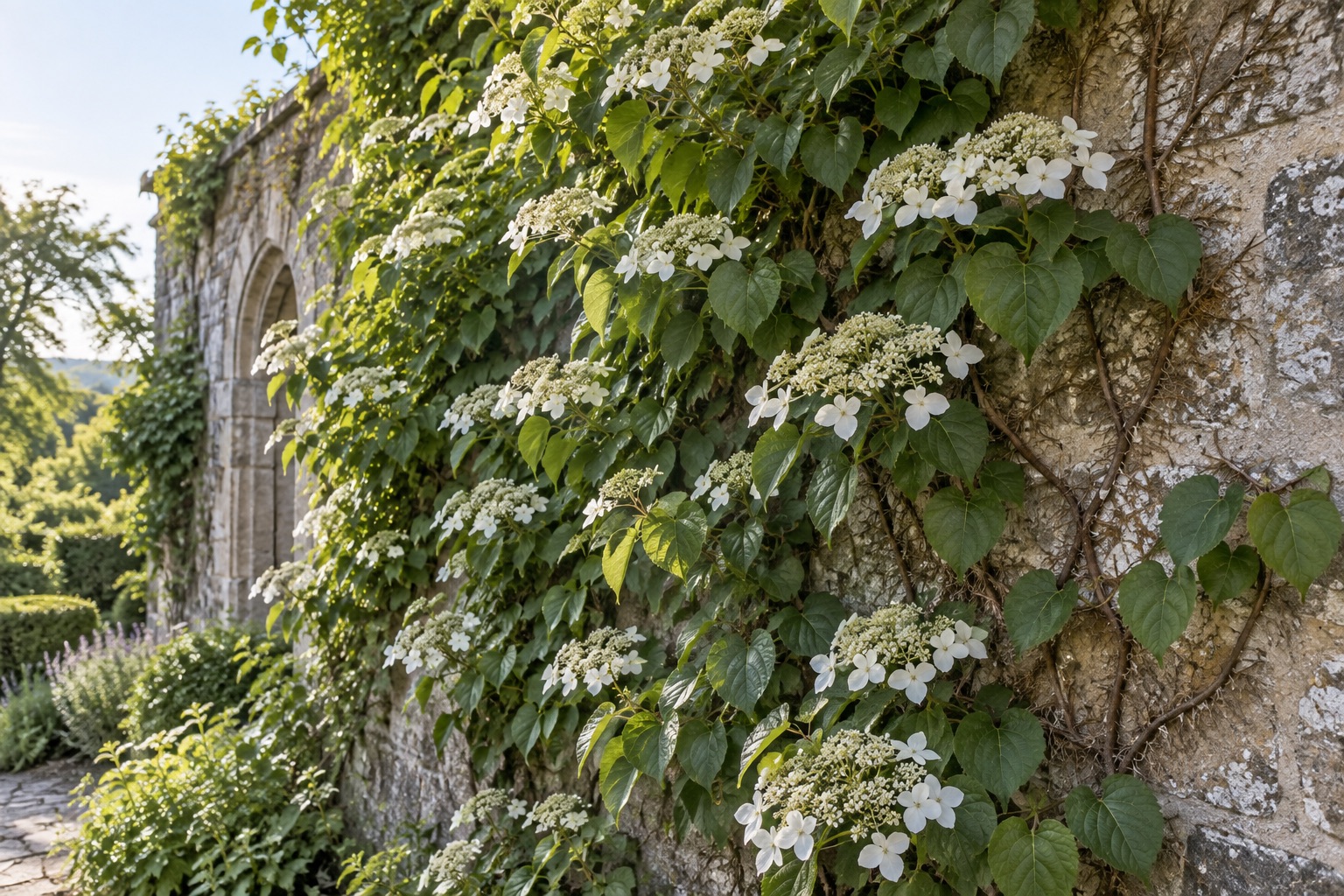
A climbing hydrangea raises a different support question from a clematis or rose. It can attach with aerial roots to a suitable surface, so you may not need a conventional trellis at all. But “can attach” does not mean that every wall, fence or tree is a good place to let it grow. The plant's eventual scale, the condition of the surface and your ability to maintain it decide the answer.
This guide uses Illinois Extension's climbing-hydrangea profile and its attachment guide to separate plant behavior from installation. We recommend deciding whether the plant should touch the surface before shopping for a product. A separate support is an option when direct attachment is undesirable, but its size and anchoring need their own evaluation.
Understand what aerial roots do
Climbing hydrangea uses small aerial roots to attach to surfaces. Illinois Extension describes that habit and notes that rough surfaces can offer a route. This is unlike a twining stem that winds around a wire or a rose cane that a gardener ties to a frame. Buying the narrowest lattice because it suits clematis would therefore start from the wrong mechanism.
Look closely at the proposed destination. Is it a sound, durable surface you intend to let a long-lived vine cover? A rough masonry wall, a wooden fence, a tree trunk and a painted siding panel are not interchangeable simply because the plant might make contact. Surface condition, moisture behavior, future repairs and ownership of the structure matter. A horticultural source can explain the root habit but cannot inspect your building or guarantee that growth will not cause problems.
Consider a detached garden wall that needs occasional repainting. Direct attachment could make that work more difficult even if the vine grows well. A separate, appropriately installed support may give you a way to manage the plant without encouraging it onto the wall. At a substantial tree, the decision is different: think about the tree's health, access and the eventual amount of vegetation. At a small decorative fence, ask whether the fence is suitable for a large, long-term vine at all.
Illinois Extension describes a potentially large plant. Treat that as a reason to plan ahead, not a claim that a specific vine will reach a particular height in your yard. Confirm the exact plant, local conditions and available space. A small starter plant can make a marginal surface appear acceptable for several seasons before access and maintenance become harder.
The extension profile gives a possible 40–50-foot scale for a vigorous plant. That number is far beyond the size of most decorative garden panels. It is more useful as a warning against a short-term wall decision than as a target: look at the whole elevation, not just the area the young plant fills today. If the only available surface is a small fence bay, choose a different site or planting plan rather than assuming a little trellis will contain the mature vine.
Choose direct attachment only after checking the surface
Direct attachment may be attractive because it can avoid the visual weight of a separate trellis. If the proposed surface is appropriate and you are comfortable with long-term coverage, it may solve the plant's climbing need. The main benefit is a continuous surface the aerial roots can encounter. The boundary is that plant attachment says nothing about the surface's condition or how it will be maintained.
Identify who owns and maintains the surface. A neighbor's fence, shared wall or building envelope is a different decision from a purpose-built garden structure under your control. Check for existing damage or areas that must remain accessible. If the surface needs future repair, consider whether the vine can be managed without making the work unreasonable. Where the surface is part of a building, seek local professional advice rather than relying on a general plant article for structural approval.
Do not force growth onto a surface you later hope to keep clear. Define an edge around windows, vents, gutters and rooflines before planting. The easiest moment to choose those boundaries is when the vine is small. If the desired covered area is narrow, a large climbing hydrangea may be a poor fit for that position even though it is capable of attachment.
| Placement | Potential advantage | Unresolved check |
|---|---|---|
| Suitable rough garden surface | Direct route for aerial-root attachment | Surface condition, ownership and long-term maintenance |
| Independent structure | Keeps the vine away from a wall you want to protect or service | Ground installation, scale and structural suitability |
| Sound tree | Natural vertical surface | Tree condition, access and effects of eventual coverage |
| Small container trellis | Movable early arrangement | Whether the complete setup could suit the plant's future scale |
Evaluate a separate support as its own project
An independent structure can keep growth off a wall, but it is not automatically the safer or easier choice. It needs a route the plant can use, enough area for the plant's potential size, and an installation suited to the site. A small ornamental obelisk might look proportionate to a young vine yet be the wrong long-term plan. Do not infer a product's capacity from its material name, weight or photographs.
Imagine a planting beside fragile siding. A freestanding panel set far enough away for access could let you guide the vine while inspecting the siding. The useful distance and installation method depend on the actual products and site; this guide cannot prescribe them. If you cannot verify a way to install a separate frame without blocking access or damaging nearby roots, reconsider the location rather than buying first and solving it afterward.
For a fence, ask whether it is genuinely independent and in good condition. A lightweight screen attached to a deteriorating fence still relies on that fence. A large vine may complicate inspection of posts and rails. Read the support maker's instructions and get advice for the structure you have, especially where wind exposure or a building connection is involved.
For a container, be realistic about time. A young plant in a large pot may be manageable for a while, but a little pot trellis is not proof of a long-term plan for a potentially large climber. If you need portability, look for local plant guidance on container care and decide what happens as the plant grows before investing in a tall decorative frame.
Plan for care and future repairs
Leave access to the plant base and to the edges of the area you want covered. Where the vine meets a wall or other surface, inspect that surface as part of normal maintenance. If you need to repaint, repair or replace it, established growth can change the scope of the job. A support plan should include that future work, not only the first season's appearance.
Set a boundary for nearby windows, doors, roof edges and neighboring plants. This is a practical drawing exercise: mark the area you are willing to let the vine occupy, then mark everything that must remain clear. If the permitted area is much smaller than the plant's possible mature spread, a different site or plant may be the honest answer. A more expensive trellis cannot shrink the plant's natural scale.
Build the care route into the drawing. Illinois Extension suggests pruning in late winter to keep the vine under control; the exact approach still depends on the plant and site. If you cannot reach the edge that will need pruning, the initial support choice makes that future work harder. A freestanding structure should leave a path around it, while direct wall coverage should leave a practical way to inspect and service the surface.
Do not substitute a product recommendation for a surface assessment. The compared retail trellises do not establish the strength or installation needed for climbing hydrangea. The wall-trellis comparison is useful for seeing published sizes and hardware questions, but it does not establish that one of those panels will carry this vine or protect a building.
Use a decision checklist before planting
- Confirm the plant is climbing hydrangea and consult locally relevant growing guidance.
- Decide whether direct attachment is acceptable for the exact surface, its owner and its maintenance needs.
- Sketch the area the plant may occupy and mark surfaces and access points that must stay clear.
- If choosing a separate support, verify its exact dimensions, climbing surface, installation method and suitability with its maker or a qualified local installer.
- Plan how you will inspect the plant base, the support and any covered surface as growth develops.
- If the site cannot accommodate the plant's possible scale, choose another location rather than a small decorative support as a substitute for space.
A rough, sound garden surface can be a sensible route where direct attachment and future coverage are welcome. A separate support is sensible where you want to preserve access to a wall and can properly install a structure with room for the plant. The most important check is the long-term surface decision; the product form follows it.
Choose the surface and the future workload together
We recommend allowing direct attachment only where the surface, ownership and long-term maintenance plan support it. Otherwise, plan an independent structure with site-specific installation, or choose another position for the plant. If you cannot answer whether the vine should cover the proposed wall, postpone the trellis purchase. The plant's attachment method makes that the first decision, not a minor afterthought.
For a different plant, return to the support finder: clematis, twining vines and roses need different kinds of climbing or tying points. That distinction is why a generic “best trellis” list is a poor shortcut here.