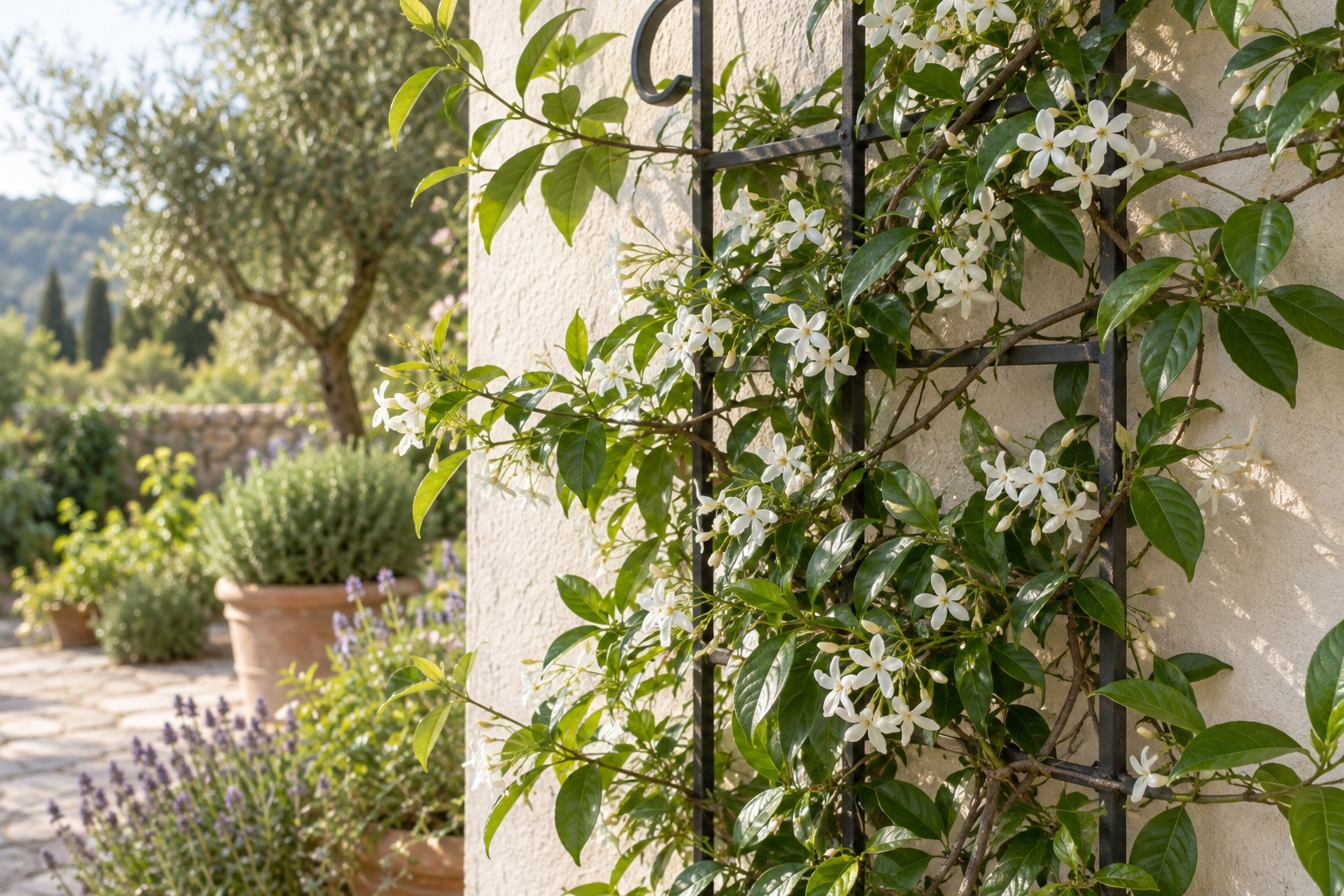
Star jasmine can make a wall or fence feel planted rather than bare, but the support still needs to match the plant and the place. This guide covers Trachelospermum jasminoides, the twining vine described in NC State Extension's species profile. “Jasmine” on a shop sign may mean a different plant, so check the botanical name before ordering a trellis.
For a known star jasmine, start with a support that gives its stems a continuous route to wind around and leaves you room to prune. An existing suitable fence may do the job; a wall panel or freestanding frame is useful when it creates a better route. This is a researched placement guide, not a trial of any particular trellis. Product strength, the condition of your wall and container stability need separate checks.
Understand the twining job
NC State describes star jasmine as a twining vine that can grow on a trellis or fence. Twining means the stem itself winds around an available member. That is different from a climbing hydrangea's aerial-root attachment and a rose cane that needs tying. If you place star jasmine beside a smooth wall without wires or lattice, the wall alone does not supply the intended twining route.
Trace a route from the plant's base to the top and sides of the planned structure. Are there members the stems can reach at each stage, or only a decorative border with a large empty center? A frame with slender verticals but no useful crosspieces may direct growth upward while giving little opportunity to spread sideways. A broad lattice or a properly installed wire arrangement can make the route more deliberate.
Do not turn the attachment habit into a claim about a named product. Manufacturer descriptions rarely prove how a living stem will use every bar. Inspect the exact member spacing and diameter, look for gaps in the route, and decide where you would guide a new shoot if it reaches open space. A loose piece of string attached without regard to the frame or weather is not the same as a planned climbing surface.
A north-facing, shaded fence and a sunny patio can have different growing conditions. Check the species guidance for your climate, exposure and care before treating the maximum size in a reference as a forecast for your plant. NC State describes growth up to about 20 feet with support under suitable conditions; that is a possible scale to plan around, not a promise that a particular planting will reach it.
Choose the layout that suits your space
For a long fence, a broad climbing surface often makes more sense than a tall, narrow feature panel. Sketch the area you want covered and leave access to the fence and plant base. An existing fence may already offer usable members. If it does not, a separate lattice or wire system can provide them, but its fixings must suit the fence and the weight and exposure it will experience. A plant source cannot certify that installation.
For a house wall, first decide whether you want a narrow vertical accent or coverage across a wider area. A purchased wall trellis may be the simpler route for a defined panel; wires can give a more adjustable layout. Either way, identify the wall material and condition, follow the product instructions, and avoid assuming a decorative bracket is a universal fastener. The wall-trellis comparison shows how much published coverage and hardware information differs between models.
For a freestanding plant in an open bed, plan access from more than one side. An obelisk can keep growth in a compact footprint, but a vine that wants more spread may quickly occupy the whole frame. Leave room to walk around it and prune. A larger panel gives more horizontal route but has a different ground-installation question.
For a patio container, treat the pot, support and location as one arrangement. A tall frame photographed in a heavy display planter does not prove it fits a smaller pot. Check how the support is secured, whether the pot has enough room for the plant's roots, and how the entire arrangement behaves in the location you have. If you cannot verify the support's connection to the pot, choose a lower, simpler form or a separately installed support with a documented method.
| Situation | Starting form | Critical question |
|---|---|---|
| Sound fence with usable lattice | Use the existing surface | Can you reach and manage growth on both sides? |
| Blank wall and narrow bed | Wall panel or properly designed wires | What fasteners and clearance suit the actual wall? |
| Open bed | Freestanding panel or obelisk | Does installed size leave room to tend the vine? |
| Patio pot | Container-specific support | Is the complete pot-and-frame arrangement stable and appropriately sized? |
Measure usable coverage, not only advertised height
Product listings often emphasize height. For a twining vine, width and member spacing can be just as useful. Measure the width of the wall, fence bay or garden space you actually want the plant to occupy. Then compare that with the panel's installed width and the position of its climbing members. A 20-inch-wide panel can be adequate for a narrow accent but cannot by itself cover a long fence section.
Keep doors, vents, gutters and paths on the drawing. If your aim is to screen a view, a support placed directly over a service point can make later access difficult. If the vine is beside a passage, allow for growth beyond the bare frame. A product's outside dimension tells you where metal or wood begins; it does not tell you the final outline of foliage.
Check whether quoted dimensions refer to the assembled product, the portion above ground, or one panel within a kit. For a wall design, note how much space brackets create behind the climbing surface and whether the maker specifies the intended fastener type. For a freestanding design, note how it enters the ground. These details determine whether the structure can be installed where you need it.
Leave a way to maintain the vine
Do not place the trellis so close to a wall or another plant that you cannot reach the interior growth. Early stems may be easy to guide, while later pruning and inspection are harder. Stand where you will work with a hand pruner. Can you see where the stems wind? Can you reach the back of the panel without pulling against the vine? If not, change the layout while the plant is small.
Plan where vigorous shoots should go when they reach the top. A continuous route can lead a stem into a gutter, over a gate or into neighboring shrubs unless you maintain an edge. The support should define the space you are willing to manage. If you want a small, tidy accent and have little access for regular care, a very large twining vine may be a poor fit for that position regardless of trellis design.
When a stem misses a member, guide it gently rather than forcing it sharply around an unsuitable bar. Keep any temporary ties accessible for later inspection. This is ordinary care guidance, not a prediction about how fast an individual plant will grow or flower.
NC State advises pruning star jasmine after flowering to keep it within the available space and notes its sticky sap. That makes access to the edges especially useful: leave a working path where you can see and cut growth that has reached a window or neighboring plant, and clean tools as the source recommends. A wall panel squeezed behind a deep shrub may supply climbing members yet make this ordinary maintenance needlessly difficult.
Check the purchase against the actual planting
- Confirm the botanical name is Trachelospermum jasminoides and consult local guidance for its suitability and care.
- Draw the intended coverage area and mark paths, doors, utilities and neighboring plants.
- Trace a continuous twining route through the exact trellis geometry.
- Check installed height and width, included hardware, mounting surface and access for pruning.
- For a pot, assess the whole container-and-support arrangement rather than choosing by support height alone.
- Ask the maker for missing installation or member details before relying on a product photograph.
If a sound fence already gives the vine a good route and you can tend it, use that before buying a feature trellis. If the wall needs a panel, choose by coverage and a verified mounting plan. If the plant is in a pot, a lower structure that clearly fits the complete arrangement may be preferable to a tall frame with uncertain stability.
Give the vine a route you can manage
We recommend a broad, accessible climbing surface for star jasmine where you want fence or wall coverage, and a freestanding form where you need the plant away from a wall. The strongest fit check is whether the stems can wind through the usable area while you can still reach them. Choose another location or a smaller planting plan if the vine's potential size would put growth where you cannot maintain it.
For published panel sizes and mounting questions, read the wall-trellis comparison. Its products are research examples; none is a verified fit for your wall or a tested support for this plant.