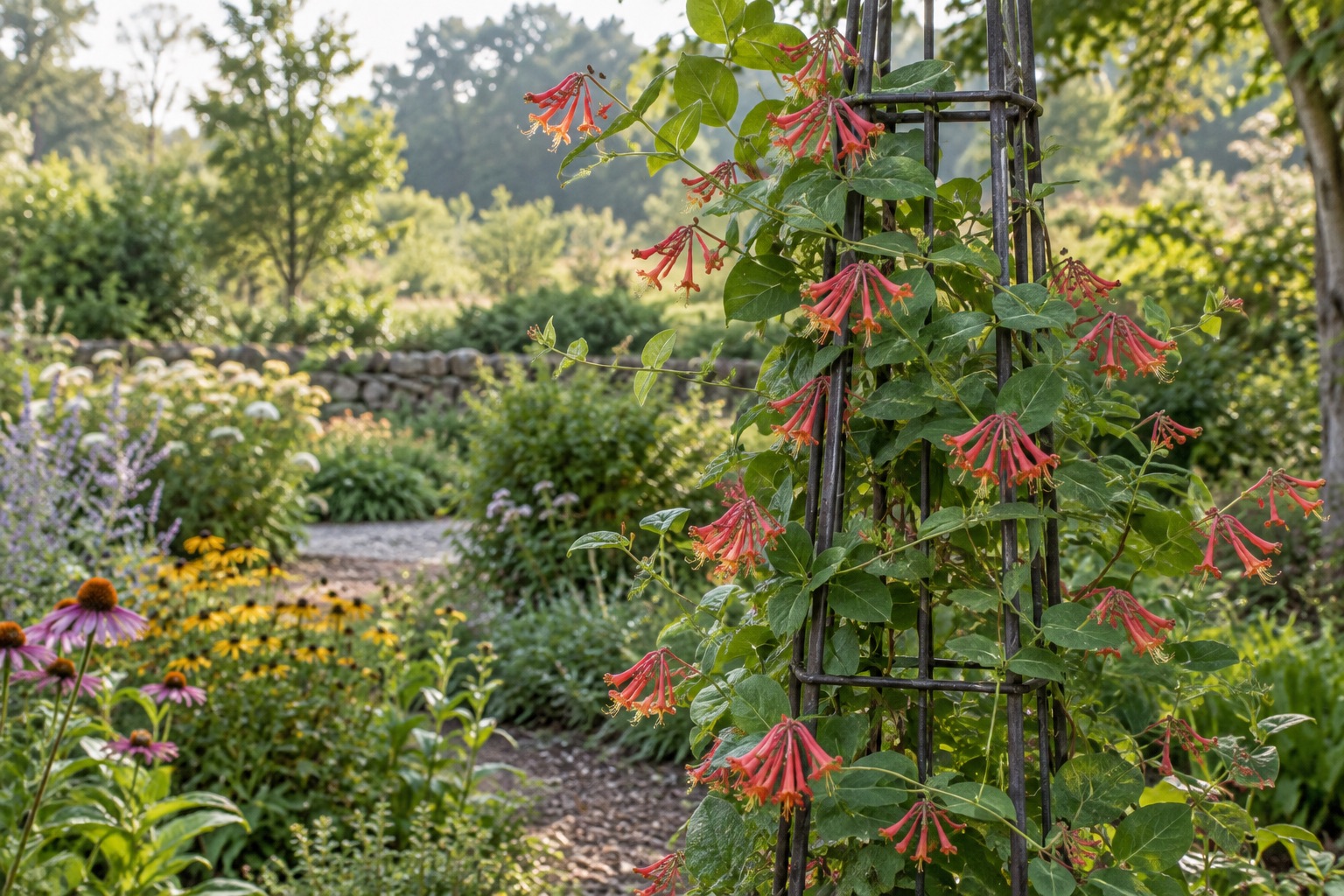
“Honeysuckle trellis” is too broad a shopping question. This guide is for coral or trumpet honeysuckle, Lonicera sempervirens, the twining vine described by NC State Extension. Other honeysuckles may have different growth, ecological or regional considerations. Confirm the botanical name and local guidance before choosing a structure.
For the named plant, begin with a support that gives the stems a route to wind around and leaves enough space to tend the vine. A sound existing fence can be a strong starting point; a panel or arbor earns its place if it solves a particular layout problem. The possible 10–20-foot scale in NC State's profile is a planning warning, not a forecast for every site.
Identify the plant and the place first
Read the plant label for Lonicera sempervirens. A common name alone can hide a different species. Illinois Extension's vine guidance advises checking a vine's regional status and suitability; use your local Extension office or state resources for that place-specific decision. Do not infer that a product sold for “honeysuckle” resolves what should be planted in your area.
Then identify what you want the plant to do. Screening a fence, framing a gate and adding a vertical accent in a bed call for different support shapes. A vine planted to cover a six-foot-wide fence bay needs room to spread sideways. A compact obelisk may keep it in one place but can require frequent control at the edges. An arbor can create a garden feature yet needs a clear route underneath and access for care.
Consider the surrounding area too. NC State's species profile includes a high-flammability caution. In settings where wildfire exposure matters, read local defensible-space guidance before placing this or other vegetation near a structure. This guide cannot set a safe distance for your property from a product listing or a general plant profile.
That caution may change the support form, not merely the planting distance. A decorative arch attached to a porch route and a freestanding panel well away from a building create different placement questions. If local guidance rules out the desired location, buying a different metal finish does not fix the placement. Move the planting plan first, then compare supports for the new position.
Give twining stems a continuous route
Coral honeysuckle twines around a support. It does not behave like a rose that must be tied along a bar, or a climbing hydrangea that may attach with aerial roots. Check the actual geometry available to a new shoot. Are there repeated vertical and horizontal members? Can a stem move from the base into the main panel? Where will it go when it reaches the top?
A broad fence lattice can offer many routes. A narrow ornamental frame may have a pleasing outline but large gaps, so some stems may need guidance to reach the next member. A simple wire arrangement can add twining points to a sound support if installed appropriately. Do not assume that extra string tied to any old frame is durable or that a damaged fence becomes suitable merely because it has narrow members.
Trace the route with your eyes from the planting spot. If the first climbable piece begins well above the crown, plan how young shoots will be guided without pulling them across a path. If a frame has only a few broad uprights, ask for member dimensions or look at another form. Plant attachment guidance tells you what sort of surface to seek; it cannot establish the strength or weather life of a commercial product.
| Form | Useful when | Question to answer |
|---|---|---|
| Existing fence or lattice | You want coverage along a boundary | Is it sound, accessible and suitable for added growth? |
| Freestanding panel | You need a screen away from a wall | How is it installed, and can you reach both faces? |
| Obelisk | A compact vertical accent suits the bed | Does its usable area match the plant's potential spread? |
| Arbor | The plant should frame an actual route | Will the clear passage remain usable as growth fills it? |
Measure the mature arrangement, not just the frame
The structure's width and height are only the bare outline. Sketch where stems might be guided and where leaves will be allowed to extend. Keep a gate latch, path or neighboring shrub visible on that drawing. If the goal is screening, mark the real area to cover and compare it with the support's usable members. A tall but narrow tower will not create a wide screen by itself.
For a fence, check its condition and the route for working on both sides. A vine can hide loose boards or hardware, making repair more awkward later. For a freestanding panel, find the installed height, ground method and access space. Included stakes or an attractive powder-coated finish are product details; neither is a site-specific load or wind rating.
For an arbor, measure the passage used by people and equipment. A maker's outside width may overstate the clear opening, and plant growth will occupy part of the interior. If you cannot comfortably pass through and tend the vine after growth, use a fence or panel instead. There is no advantage in forcing a plant over an arch that compromises the garden's main path.
Compare two sketches: one showing bare uprights and one showing the vine allowed to extend beyond them. The second drawing should mark the passage you must keep open and the side where you will work. This does not predict an exact mature outline; it exposes whether the chosen form leaves any room for growth and care. If both sketches occupy the same tight corridor, a flatter support along a boundary is easier to manage.
A container arrangement deserves separate scrutiny. The plant's roots, pot weight when wet, frame attachment and exposed height all affect the complete setup. A product photo cannot prove stability. If the pot is small or the location exposed, a lower support or another planting site may be more sensible than a tall arch in a container.
Keep access for care and local checks
Leave room to prune and redirect shoots. A trellis at the rear of a deep bed may be hard to reach once the vine grows. Place it where you can get to the base and the edges, and decide which neighboring plants you are willing to let it approach. Make the support define a manageable shape rather than relying on last-minute trimming when it reaches a window or gate.
Review local guidance for the plant and site before installing. Regional suitability, wildfire precautions and planting care are location-specific. Neither the NC State profile nor the national product listing can answer every local question. If your exact vine proves to be another honeysuckle species, stop using this support plan as if the species were interchangeable.
Do not overinterpret a flowering photograph. It can show an intended effect, but it does not tell you how the structure was installed, how much pruning it required or how the plant performs in your region. Use the photograph for visual preference and the published dimensions and guidance for the practical decision.
A good support should also keep the plant's base easy to find. That helps you see where new stems start, reach the soil for routine care and identify shoots that have wandered into another plant. If a design hides the base behind heavy decorative work, consider whether a simpler lattice would make the garden easier to manage through the seasons.
Run a short pre-purchase check
- Confirm Lonicera sempervirens and consult local planting and regional-status guidance.
- Choose the job: boundary coverage, independent screen, vertical accent or route framing.
- Measure the area the grown plant may occupy, including paths and neighboring plants.
- Trace a twining route from the base through the exact support members.
- Read the maker's installation method and check the fence, wall, soil or pot involved.
- Stand where you will prune and guide the vine; change the layout if the important edges are unreachable.
Use a sound existing fence when it supplies the route and coverage you need. Choose a freestanding panel when you want a screen without relying on a wall. Choose an arbor only if you want a passage and can preserve its clearance. These are form recommendations, not endorsements of an unverified product.
Let the site decide the form
We recommend starting with the simplest accessible structure that fits the intended shape of the plant. For a boundary, that is often the existing fence or a properly installed lattice. For an open bed, a panel or obelisk can work if its size and ground method make sense. If your main aim is flowers over a walkway, solve the clear-opening and maintenance questions before selecting an arbor.
The final check is whether both plant and gardener have a route: the stems need members to wind around, and you need access to keep growth within the planned space. If either route is missing, choose another structure or position. See the support finder for a plant-and-setting checklist.