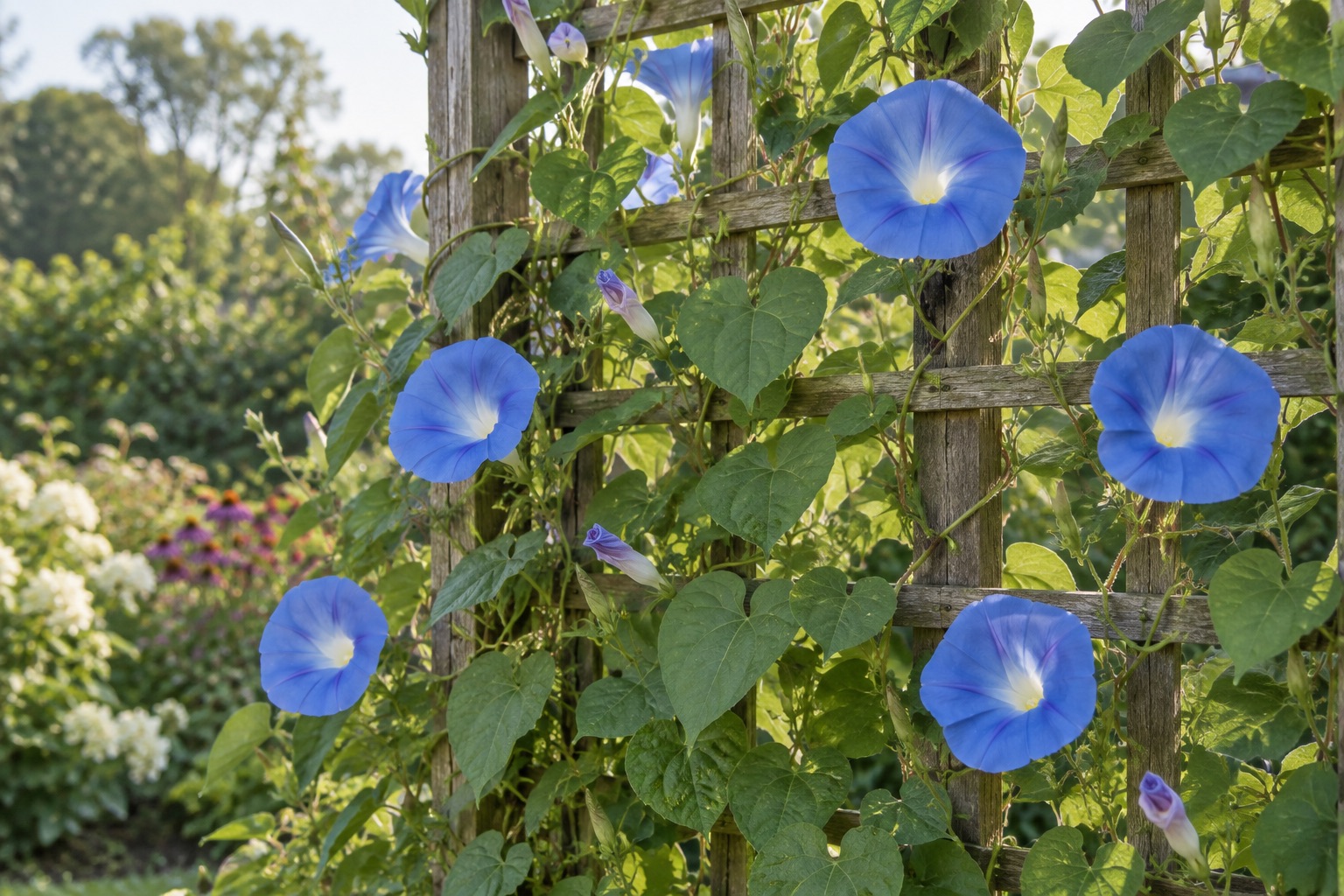
A morning glory can make a plain fence colorful quickly, but the support has to make sense for a vigorous seasonal vine rather than only for a small seedling. This guide covers Ipomoea tricolor as described by Illinois Extension. Plants sold under “morning glory” are not always the same species, so confirm the packet or plant label and check local guidance before applying this plan.
For this plant, we recommend using a sound existing climbing surface where it already fits the location, or a simple freestanding support you can reach and clear at season's end. The choice is as much about where the vine should not go as where it should climb. Illinois Extension describes potentially vigorous growth and reseeding for the species; those are planning reasons, not a prediction of what one planting will do.
Start with the exact vine and local rules
Read the botanical name on the seed packet. If it is not Ipomoea tricolor, the Illinois profile used here may not describe its size or behavior. Consult local Extension or other authoritative guidance about the particular species, especially where self-seeding or regional restrictions matter. A product description that says “for morning glory” cannot settle the plant-identification question.
The Illinois source describes a possible 10–20-foot climbing scale and the ability to cover structures quickly. Treat those figures as a reminder to leave space, not a guaranteed height or a reason to buy the tallest product available. A vine in a different climate, site or season may behave differently. The useful decision is whether your chosen structure provides an intentional route and a boundary you can maintain.
NC State Extension's I. tricolor profile describes twining stems and an 8–10-foot range in its context, shorter than the Illinois profile's 10–20 feet. These are different source descriptions, not an invitation to average the numbers. Use local conditions and the exact cultivar to plan a manageable route, and leave room to redirect growth if it exceeds the frame.
Think through three common sites. A chain-link fence can already supply many places for stems to wind, but growth may pass through to the far side or toward a neighbor. A patio container may keep planting contained, but the support and pot must work as one stable arrangement. A freestanding bed trellis can put flowers where you want them, provided you can reach both faces and remove or manage growth after the season.
Choose a seasonal climbing route
Morning glory is a twining vine. It needs members its stems can wind around; a broad smooth post alone offers less of a route than wire, lattice or another repeated framework. Illinois Extension's attachment guide explains the underlying distinction between twining and other climbing methods. Inspect the actual product geometry rather than assuming every tall garden ornament supplies that route.
At the base, plan how shoots reach the first member. A trellis set too far from the planting can require repeated redirection across bare ground. At the top, plan what happens when growth exceeds the intended area. Can you turn it back toward the support, prune or otherwise manage it without reaching into a gutter, utility or neighboring shrub? A workable route has a beginning and an end.
A panel with many small openings may guide growth across a wide area. A narrow obelisk may concentrate it in a small bed. Netting can be light and flexible, but its exact material, fixings and removal method matter; a tangle left on the frame at season's end may be more work than a simple rigid lattice. Choose based on the garden job and your cleanup plan, not on the most elaborate product photo.
| Situation | Starting choice | What to check |
|---|---|---|
| Sound existing fence | Use available narrow members | Property boundary, access to both sides and where growth may spread |
| Open bed accent | Freestanding panel or obelisk | Installed footprint, route for stems and end-of-season access |
| Patio pot | Pot-specific support | Complete arrangement's stability and manageable vine size |
| Raised-bed system | Compatible frame and string trellis | Exact bed dimensions, connectors and string pattern |
Place it where spread is manageable
Draw the support on a plan that includes paths, windows, neighboring plants and property lines. A frame that fits physically may still put a vigorous vine where it blocks a walkway or climbs an unintended plant. Choose a position you can visit routinely. If you need the vine to stay inside a narrow strip, define how you will maintain that edge before planting.
For a fence, ask whose fence it is and whether both sides can be tended. A vine may be easy to admire from one side and difficult to remove or redirect from the other. If the fence is weak or shared, a separate freestanding support on your side may be a better option, though it still needs its own installation. Avoid treating a damaged fence as a free trellis just because the openings are convenient.
For a raised bed, compatibility can become the main constraint. The Vego VTT50 profile examines one frame whose manual specifies different connector holes for particular Vego bed styles. That makes it a research example for owners of those beds, not a generic answer for any box. If you use another bed, verify dimensions and connectors rather than extrapolating from a photograph.
For a container, consider the exposure of a tall, leafy structure and the pot's connection to it. Product pages rarely establish stability for every pot and site. A lower, accessible support or a ground-based frame near the pot may be easier to evaluate. If the intended arrangement cannot be secured under the maker's instructions, change it before planting.
For a balcony or other small paved area, also think about where fallen flowers, leaves and seed heads will end up. The plant may be easy to reach at eye level but difficult to keep out of a neighboring railing. A support that is a little shorter and easier to clear can serve the seasonal display better than a taller form that invites growth into shared space.
Plan the end of the season from the beginning
Seasonal vines invite a different maintenance question from a permanent climber: can you clear the support without dismantling everything around it? A rigid lattice with access from both sides may be simpler to clean than closely woven netting. A freestanding product that the maker allows you to disassemble or store may suit a small bed where the planting changes each year. Check the actual manual before assuming a frame is meant to be taken apart repeatedly.
Illinois Extension notes heavy reseeding for I. tricolor. Check local guidance and watch how seed heads develop if reseeding matters in your garden. Avoid making an unsupported promise that one cleanup step will prevent every volunteer plant. The practical point is to include monitoring and cleanup in the choice of location. A vine allowed to spill into inaccessible shrubs can make that work harder.
Think through the material you will be cleaning, too. If stems have wound tightly through fine netting, separating them can be a different job from clearing a rigid panel with larger openings. A replaceable string surface may let you remove the plant and string together, but only if that follows the exact product instructions and local disposal guidance. This is a reason to examine the maintenance method before choosing the most intricate climbing surface.
Do not buy a permanent, elaborate frame solely because the vine could reach a long length. If a sound fence already gives a manageable route, the extra structure may add little. If you want an annual display in a new position, buy for easy access and a documented installation. A simple support can be the better designed solution.
Check the purchase and planting together
- Confirm the exact species and follow local guidance for planting and reseeding.
- Mark the intended coverage area and everything that must remain clear.
- Trace the twining route through the structure from soil to its upper and side edges.
- Check installed dimensions, mounting or ground method, and access to both faces.
- For a raised bed or pot, verify the whole system and exact model compatibility.
- Plan how you will manage spread and clear or maintain the support after the season.
If you already have a sound fence in the right place, try that route before buying another frame. If you need flowers away from a boundary, choose a freestanding form with enough climbing members and a clear installation plan. If the plant would reach places you cannot tend, change the planting position rather than depending on the trellis to stop it.
Choose for control as well as display
We recommend a support that makes the vine's path visible and reachable. A fence works when you can manage its edges, a freestanding panel works when you need independent placement, and a compatible bed frame works when its exact connectors and dimensions have been checked. The strongest buying test is whether you can picture both the fully grown display and the end-of-season cleanup.
Read the Vego profile if you are comparing a raised-bed frame. Check the exact bed size and connector layout against Vego’s instructions.