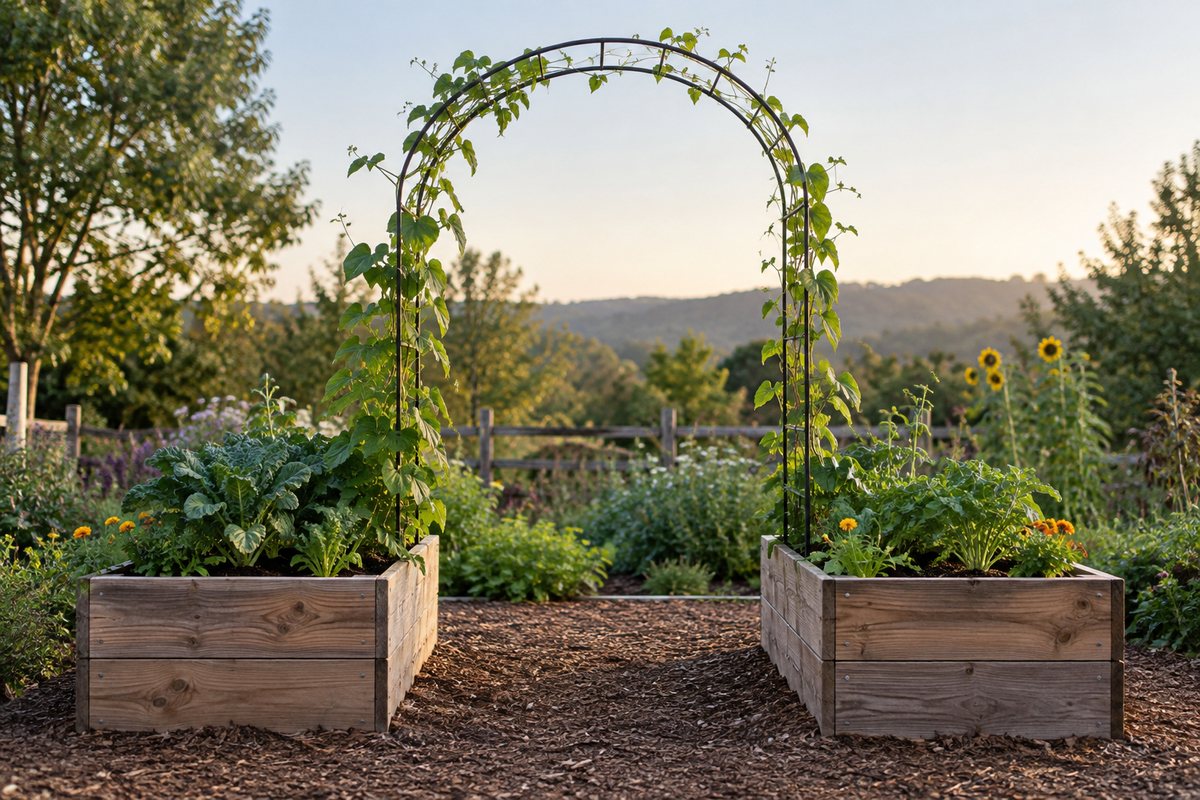
The Gardener's Supply 2 × 4 ft Arch Trellis for Planter Boxes, SKU 12072, is a system accessory first and an arch second. The maker describes it as fitting the Lifetime corners of its 2 × 4 ft elevated planter boxes, or spanning between compatible elevated beds. It lists an assembled size of 48 inches long, 24 inches wide and 48 inches high at the center. If you already own the right beds, that specific connection could be more useful than finding ground space for a standalone arch. If you do not, confirm the whole bed arrangement before considering this product.
Our verdict is to shortlist SKU 12072 only for a verified Gardener's Supply planter layout where a four-foot arch serves the planting plan. Its benefit is a documented kit for that ecosystem, with a linked assembly sheet. Its drawback is the tight compatibility and the ambiguity a casual shopper might feel about “walk-under” use versus the product's four-foot arch height. Measure actual headroom in the intended bed arrangement.
Start with the planter you actually own
The product title names 2 × 4 ft planter boxes, and the listing says it fits into the maker's Lifetime corners. That is a more specific promise than “works with raised beds.” Write down the maker, exact bed model, corner hardware, arrangement and distance between beds. Compare them with the current arch instructions or ask the retailer to confirm compatibility. A wooden planter of the same outside size may not have the same connector system.
Imagine one matching elevated planter with an annual vine growing from the two long sides. A compact overhead route may add growing area above the bed. Now imagine two parallel beds with a path between them. The maker mentions spanning between beds as a walk-under arrangement, but the arch itself is listed at 48 inches high at center. Bed elevation changes the total installed height; the exact arrangement must be measured before anyone can call it comfortable passage. A third gardener with a ground-level bed has an even different height and attachment problem. The arch dimensions alone answer none of these complete-layout questions.
The product listing also mentions a separate 12-inch Arch Extension that can bring its center height to 60 inches. That is an accessory, not included height. Do not calculate clearance from the extension unless you have selected and verified that exact configuration. The starting kit's published dimension remains 48 inches at center.
Make the assembly sheet part of the purchase check
The maker's assembly sheet lists three curved panels, two straight panels, four connectors and an included hex key. It says to remove the screws already in place, assemble step by step, and periodically retighten screws and fittings. That last instruction is an ownership cost: plan to reach and inspect connections after the structure is planted, rather than allowing vines to conceal every joint.
The assembly sheet is short. It does not establish how a mismatched bed corner should be adapted, nor does it give an independently tested loaded-vine rating. Do not drill a different planter or improvise brackets on the assumption that the same steel arch will behave as designed. If exact compatibility cannot be confirmed, a separate freestanding or bed-independent support is the cleaner buying decision.
The retailer lists low-carbon steel with a brown powder coating and a 30-pound product weight. Weight helps you plan handling; coating is a finish description. Neither proves wind behavior, long-term corrosion life or safe support for a heavy mature plant. The planter, its corners, the arch and the growing vine form one installed arrangement that needs a site-specific assessment.
Choose a plant and a harvest route
The listing names cucumbers, squash, clematis and morning glory. Those plants do not all attach or occupy space in the same way. Illinois Extension
For an elevated bed, imagine reaching fruit or tying stems at the arch top. Measure the combined bed and arch height at the working edge, not just the 48-inch center arch figure. Ask whether you can reach and inspect both sides without stepping into the bed. If the planter is against a wall, the rear half of the arch may be inconvenient for training, harvesting and periodic screw checks. For a low bed, the same arch might be easier to tend from outside but less useful for walking beneath.
| Decision | Published detail | Required check |
|---|---|---|
| Connection | Fits named Lifetime corners of 2 × 4 ft elevated planters | Exact bed model and corner design |
| Space | 48 × 24 × 48 in assembled at center | Total installed height and clear path in your layout |
| Assembly | Five panels, four connectors, hex key | Current parts and accessible screw maintenance |
| Plant | Several vines named in listing | Attachment, member geometry, crop weight and reach |
Compare a dedicated bed arch with independent supports
The arch's specific integration can reduce the guesswork of how it connects to the matching planter. That is its strongest use case. It is also the reason to reject it when your bed is from another maker or when you want to move the support elsewhere next year. A freestanding arch like the Modena works from the ground and solves a passage design question, but then soil anchoring is central. A folding panel serves a smaller seasonal planting area and stores flat; it does not create an overhead route.
If you have Vego beds, their VTT50 string trellis illustrates a different brand-specific system: a vertical frame and replaceable string, not a Gardener's Supply arch. Compatibility is not transferable just because both attach to raised beds. Choose the system you actually own, then compare exact lengths, corners and required access.
For a gardener hoping to create a human walkway between beds, do a full side-view sketch. Include planter height, arch rise, distance between the bed edges, path surface and your preferred overhead clearance. The marketing phrase “walk-under” is not a dimensional guarantee for the specific configuration you will build.
Account for care after the first season
The assembly sheet calls for periodic retightening. Keep the hex key where you can find it and leave access to the four connectors. Inspect the coating and any damaged areas in the course of normal bed care. We do not have a measured service-life test or a site-specific load rating. If the arch carries annual vines, remove spent growth without twisting or stressing joints; if it carries a perennial, plan future pruning access before the frame is crowded.
Don't assume the optional bench or extension pictured in related marketing is included with SKU 12072. Check the current package contents and any separate accessory cost if your garden design depends on them. Prices and stock can change, so this review deliberately does not quote an enduring price.
Our buying verdict
Shortlist this 2 × 4 ft arch when you have confirmed compatible Gardener's Supply Lifetime corners, a plant that can use the actual members, and a measured height that serves your bed arrangement. The product's strongest supported advantage is its specific ecosystem connection. Its main limitation is the same specificity: without the right planter, it is the wrong hardware. Confirm the full installed layout and reachable fasteners before buying.
Choose a freestanding support if your beds are incompatible or you need a flexible location. Choose a taller, independently assessed arch if clear walking headroom is the goal. No exact Amazon offer or affiliate destination is matched here, and the product has not been field tested by us.