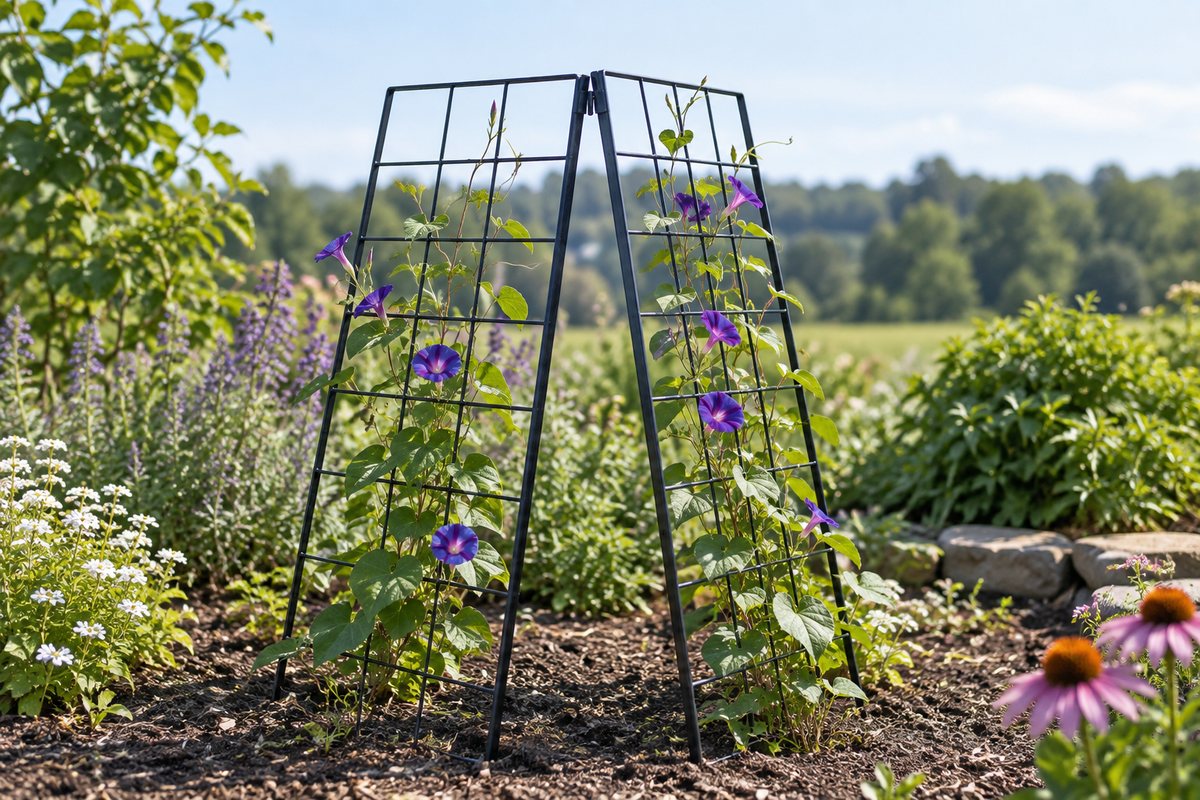
A folding trellis earns its place when you need a seasonal climbing surface and a way to clear the bed at the end of the year. Gardener's Supply lists its Two Panel Folding Trellis, SKU 12062, at 35½ inches wide and 58 inches high overall, with 48 inches visible after installation. The two hinged panels can stand flat or form an angle. That flexibility is the main reason to investigate it for a compact flowering vine or a small vegetable bed. It is not a substitute for a permanent, tall screen.
Our recommendation is conditional: choose this model for a modest annual climber when four feet of visible height, the published grid, and seasonal storage suit your garden. Its value is the foldable format and a maker-published installed height. Its main drawback is scale. A vigorous vine that needs more height or broad coverage can outgrow the useful surface quickly.
Decide whether four visible feet solve the job
The maker gives an overall height of 58 inches and an installed height of 48 inches. The difference matters more than the headline measurement. A gardener planning against a fence may picture nearly five feet of foliage above the soil; the published installed figure is one foot shorter. Mark four feet on a stake where the trellis will go. If the height does not provide the screen or climbing route you need, the folding feature will not make up for it.
For a raised bed with an annual morning glory, four feet might be a useful first stage, especially if you can guide growth along another sound structure. Illinois Extension describes morning glory as a twining vine, so the question is whether the vine can wind around reachable members and where it will go after reaching the top. The maker does not give the wire diameter or a plant-specific capacity. A four-foot standalone frame should therefore be chosen for a deliberately modest display, not assumed to contain every vigorous annual vine.
For a narrow patio border, the 35½-inch overall width can be helpful: it gives more lateral surface than a small obelisk without the footprint of an arbor. But check where the panel sits relative to the path and where you will stand to untangle shoots. A trellis that fits a bed dimension can still block harvesting, pruning or access behind it.
Use the hinge to match the space
Each panel is listed as 17½ inches wide. The maker describes two arrangements: flat against a wall and angled around a corner or within a raised bed. That creates a real choice. A flat presentation offers a wider visual plane; an angle can reduce the width of the footprint and give the structure some geometric depth. Neither arrangement proves it will remain stable in your soil or in exposed wind. The retailer does not publish a site-specific wind or loaded-vine rating.
Try a paper layout before ordering. Draw two 17½-inch leaves joined at the center. Rotate them to the angle you need, then reserve space for plants, roots and hands. In a square raised bed, an angle might frame one corner while leaving the middle for other crops. Along a long fence, flattening the panel may use more of its width but still leaves the need to verify how it stands and whether the wall is being used for support. The product listing's phrase “against a wall” is placement advice, not wall-mounting hardware instructions.
The ability to fold flat is most valuable when you actually remove and store the support. If your vine is perennial and you expect to leave a frame in place year-round, compare a fixed wall panel or sturdy freestanding form instead. A hinge is a useful ownership feature for changing seasonal plantings, not inherently a stronger climbing surface.
Check the grid against the plant
Gardener's Supply lists openings of 5½ inches high by 6 inches wide in powder-coated steel wire. The generous openings make it easier to reach through for harvesting, which may suit beans or small cucumbers. A flowering vine may need to be guided to the next member as it grows. We cannot infer wire diameter, stiffness, load capacity or ease of twining from the opening size alone. Look closely at the current product images and ask the maker for member details if the exact plant needs a narrow surface.
| Situation | What the product offers | What to verify |
|---|---|---|
| Small seasonal bed | 48 in installed height and fold-flat storage | Climbing route, soil placement and end-of-season cleanup |
| Harvesting through a panel | 5½ × 6 in openings | Whether your crop needs finer intermediate support |
| Permanent privacy screen | 35½ in overall width | Four-foot height may leave the view open above it |
| Wall-adjacent vine | Panels may be placed flat | Do not assume wall brackets or anchors are included |
For a clematis, Illinois Extension emphasizes graspable narrow members for vining types. Because the maker does not state this wire's diameter, this model is not yet our clematis pick. An owner might add a suitable narrow route if the maker permits it, but that requires its own installation check. Plant behavior should direct the product question, rather than treating “flowering vines” in a sales description as proof of fit for each species.
Plan installation and the end of the season together
There is no assembly manual linked on the product listing we reviewed. The overall-to-installed height difference indicates that some part of the panel enters or sits below the visible ground line, but it does not tell us the required soil depth, firming method or tolerance for a loose raised-bed mix. Before buying, request the current installation instructions for SKU 12062 and compare them with the depth and condition of your soil. Do not lean the panel against a fence and assume the fence solves anchoring.
Imagine the same bed in October after an annual vine has finished. A folding frame can come out, be cleared and stored flat. That is easier to plan for than a fixed arch, but stems may wrap around the grid and hinge. Leave enough access to unwind or cut away annual growth without bending the wire. If the product must stay in place because roots or other plants have engulfed it, much of the storage advantage disappears.
Powder coating is a published finish, not a measured service life. Inspect the frame, hinge and any damaged finish at the beginning and end of the season. The maker has not supplied a corrosion guarantee in the cited details. For a permanent screen in a damp or exposed location, compare a product with explicit installation and maintenance instructions and a size that already meets the desired coverage.
Compare the closest alternatives
The Vego VTT50 is a different seasonal system: it uses replaceable jute string within a frame and is tied to compatible raised-bed configurations. It makes sense only if you want that bed-specific installation and its taller growing area. The folding trellis is simpler for someone who wants a movable grid and does not own the matching Vego setup. Neither has a verified strength rating for your garden.
An Essex Round gives a taller visible focal point but a narrow circular footprint and different seasonal handling. A fixed wall panel, such as the Exeter large, spreads a vine across a vertical surface and brings wall anchoring into the decision. Decide first whether your job is a four-foot seasonal bed support, a tall freestanding feature or broad wall coverage. Those are different purchases even if all are called trellises.
Our buying verdict
We would shortlist the Two Panel Folding Trellis for a gardener who changes annual plantings, wants to store the support flat, and has checked that 48 inches of visible height is enough. The hinge and generous grid are specific benefits for layout and access. The material limitation is the modest installed height and the absence of detailed installation and wire-diameter data in the cited listing. Confirm those details for your soil and plant before purchase.
Choose another form if you need a permanent tall screen, a known narrow member for clematis, or a load-rated structure for a mature woody vine. Check the current black SKU 12062 and its installation details at the maker before ordering.