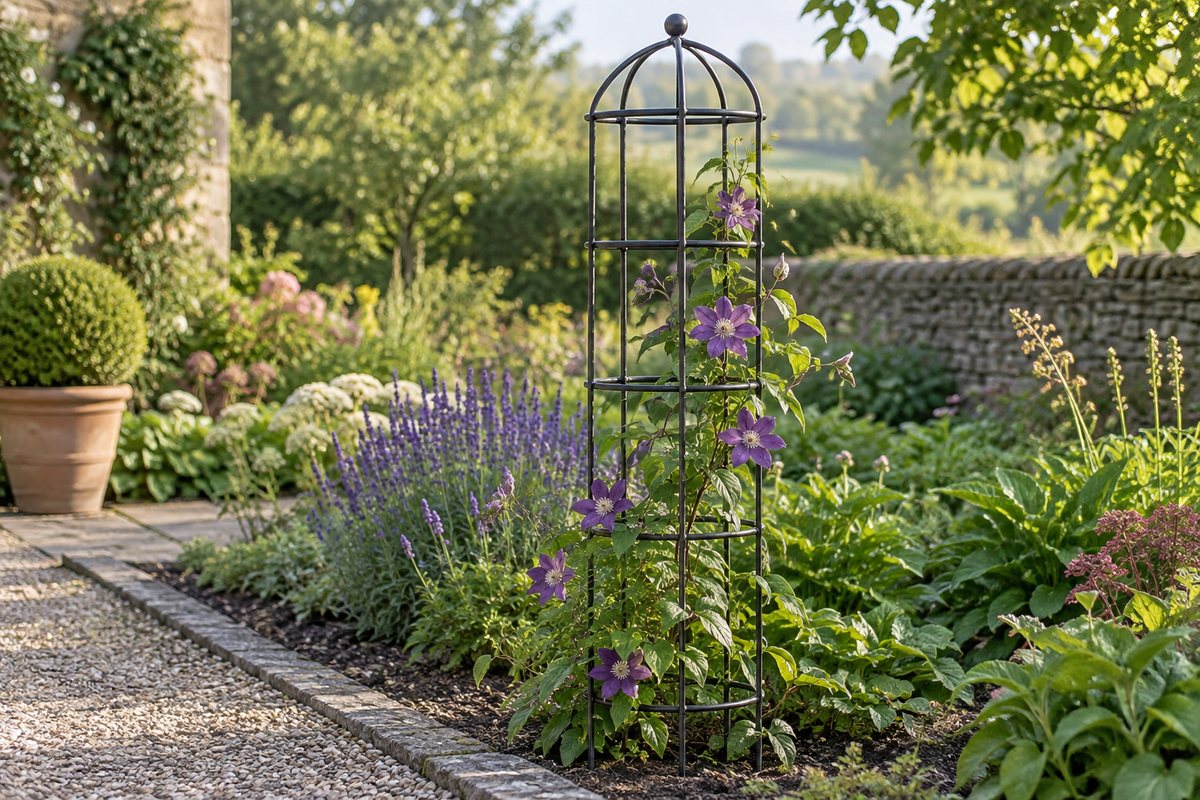
The seven-foot Essex Round Trellis has a useful distinction for clematis shoppers: Gardener's Supply lists ⅜-inch steel tubing and says the structure stands about six feet high after installation. Those details help answer two practical questions—whether some of its members are narrow enough to investigate for a leaf-petiole climber, and how tall it will actually look in a bed. The listing also mentions flat stock, so the tube measurement does not describe the whole climbing surface.
This profile covers the seven-foot Essex Round shown as SKU 11952 on the maker listing reviewed September 27, 2026. We recommend investigating this model for a compact open-bed clematis when you can inspect its complete geometry and installation. A broad fence or wall display calls for a different form.
Use the installed height in your garden plan
The published outside diameter is 15¼ inches and the overall height is seven feet. Gardener's Supply says it stands approximately six feet high when installed. Put the installed figure on your garden drawing; the remaining length is not a second foot of visible climbing room. Compare that height with the named clematis variety's expected mature size, and allow for the plant's spread around the frame.
Imagine a narrow bed where you want a flowering focal point. The round footprint may fit easily on paper, but the foliage and your working space will extend beyond fifteen inches. Lay out the circle on the soil, then stand at the places you will use for guiding and pruning. A frame that technically fits between shrubs may still leave you unable to reach the back of the vine.
Now imagine a clematis beside a long fence. The same six-foot visible height may be fine, but the round frame supplies a narrow column rather than the broad coverage you may want. If the fence is sound and can carry a properly installed narrow climbing surface, it can be a simpler solution. The Essex model is best investigated when a freestanding vertical form is itself useful.
In a container, the listed diameter is not enough to decide fit. The frame, pot, growing medium and exposed plant create one arrangement. The listing does not establish stability in a particular pot or location. Do not move from “fifteen-inch base” to “fits any fifteen-inch pot” without an exact installation method and site assessment.
Examine every member the vine can reach
Illinois Extension's clematis publication explains that vining clematis use leaf petioles to catch narrow members and advises adding graspable material when a support is over ¾ inch in diameter. Its attachment guide also points toward wire and thin lattice. The listed ⅜-inch tubing is therefore a useful starting fact, but it does not settle the whole route.
Gardener's Supply also names flat stock. The listing does not give us every width, angle or spacing a growing shoot would encounter. Trace a path from the base through the frame in the current product images or a detailed drawing. Where does the first narrow member begin? Can a leaf petiole catch another member after the plant reaches a decorative section? If the route stops, an added narrow material may help if it can be attached under the maker's instructions.
Do not assume that all clematis behave alike. Confirm that your plant is a vining form and find its mature dimensions. A non-vining type may need a different arrangement or more tying. A compact cultivar could suit a modest tower more readily than a vigorous one. The support can be a good physical candidate while still being wrong for a particular plant.
| Question | Published answer | Next check |
|---|---|---|
| Visible height | About 6 ft after installation | Compare with the exact clematis and placement |
| Ground footprint | 15¼ in diameter | Allow room for the full plant and access on all sides |
| Narrow member | ⅜ in steel tubing listed | Inspect flat stock and the full climbing route |
| Structural fit | No site-specific rating established here | Read current installation instructions and assess soil and exposure |
Prepare the bed before installing the frame
The difference between overall and installed height tells you that part of the structure is intended to be placed below the visible portion. Check the current assembly and installation instructions for the exact seven-foot variant. Determine how the maker expects it to enter the ground, then see whether that method works in your soil and position. An attractive powder-coated finish does not answer the anchoring question.
If the clematis is already established, plan the work around its roots and stems. Installing a freestanding frame close to the crown may be easier before planting than after several seasons of growth. If you are moving an existing vine, do not assume you can slide a tall obelisk into place without disturbing it. Consider whether a separate panel installed at a safer distance gives a clearer route.
Leave access to inspect and maintain the frame. A compact round support may be reachable from several sides in an open bed, which is one of its practical advantages. It loses that advantage when placed against a wall or deep behind another plant. Check the side you cannot see from the usual viewing point; that is often where ties and crowded growth go unnoticed.
Know when another form fits better
A sound fence with suitable narrow wire or lattice is a better starting point when you want to spread clematis along a boundary. A wall panel can make sense for a defined vertical area if the wall and fixings can be assessed. A larger freestanding panel may offer more breadth for a plant whose spread exceeds a compact obelisk. None of those alternatives is automatically safer; each needs its own installation.
Our four-support comparison places Essex Round beside three other maker listings. Its closest value is showing how overall and installed dimensions, footprints and unknown member thickness differ. The H Potter GAR470 is taller on paper, but we do not have its complete member geometry. Do not choose it simply because it has the largest height figure.
If your main concern is an exact retail offer, pause. This page has not matched a current Amazon variant to the maker's seven-foot SKU. It does not claim a price, inventory, customer rating or commission link. The product can still be studied at its maker page while the commerce gate remains closed.
Make the purchase decision in the bed
- Confirm a vining clematis and record its expected mature height and spread.
- Mark a 15¼-inch base in the intended place, then allow space for plant growth and your hands.
- Plan for about six feet of visible structure, subject to current instructions and actual installation.
- Inspect the ⅜-inch tube, flat stock and crosspieces as one continuous climbing route.
- Read the exact installation method and assess the soil and exposure before committing.
- Use an existing sound broad climbing surface if the goal is coverage rather than a focal point.
We recommend investigating the Essex Round when you want a compact freestanding shape and its published narrow tube gives you a promising clematis starting point. Its main advantage is that the maker gives both the installed-height distinction and one relevant member dimension. Its main limitation is the incomplete description of the rest of the route and site-specific installation. Resolve those questions before treating it as a fit for your plant.