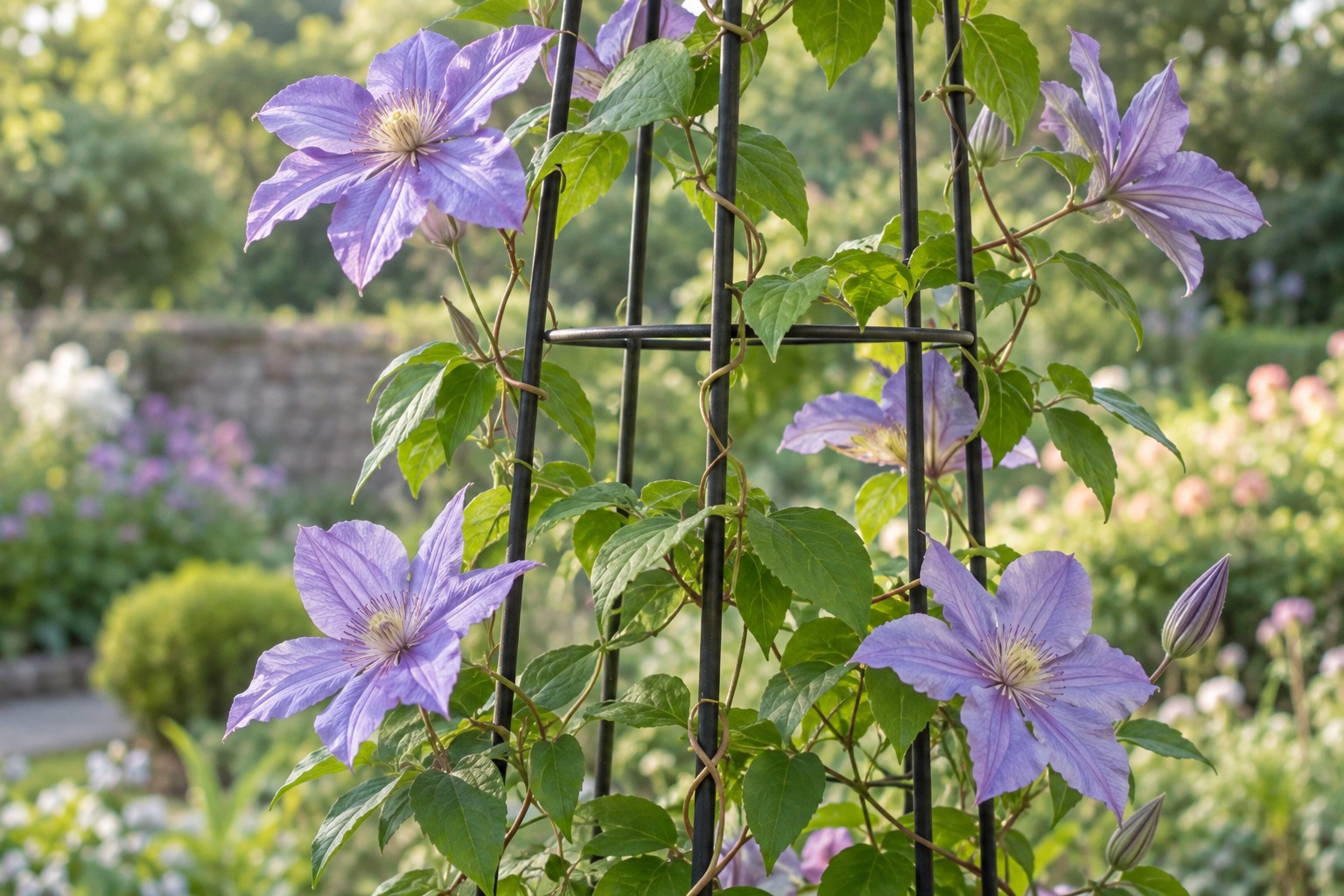
Four attractive freestanding structures can look interchangeable in a product grid. For a vining clematis, they are not. The plant's leaf petioles need narrow places to catch, while the gardener needs an installed height and footprint that suit a named cultivar. We recommend choosing the climbing route and placement first, then comparing these four maker listings. If a sound existing lattice already gives your plant that route, a new obelisk may be unnecessary.
The examples here are Gardener's Supply's Essex Round, Essex Square and Oxford Pyramid, plus H Potter's GAR470. Their published dimensions were reviewed September 27, 2026. Illinois Extension's clematis publication explains why a narrow climbing surface matters; it does not approve any product.
Compare installed size before visual style
Product pages may put overall height in the title even when part of the frame enters the ground. That distinction changes the planting plan. The two seven-foot Essex variants are listed at about six feet installed. If your cultivar needs a different scale, choosing by the seven-foot label can mislead. The H Potter model lists a taller overall dimension, but that alone does not tell us its installed height or whether its members suit clematis leaf petioles.
Swipe across the table to see every comparison question.
| Product | Published size | Best reason to investigate it | Open fit check |
|---|---|---|---|
| Essex Round Trellis, 7 ft | 15¼ in diameter × 7 ft overall; about 6 ft installed. Listing names ⅜ in tubing and flat stock. | It supplies one narrow tube dimension relevant to the clematis question. | Other reachable flat members and site installation are not fully established. |
| Essex Square Obelisk, 7 ft | 15¾ in square × 84 in overall; 72 in installed. | A square footprint may align better with a rectangular bed plan. | Check the dimensions and spacing of members the vine actually reaches. |
| Oxford Pyramid Trellis | 15 in square at base × 72 in installed; ground stakes included. | A similar installed height in a tapered form. | Member thickness, useful route and stake installation need confirmation. |
| H Potter GAR470 | 101 in overall; 12 in inner square and about 16 in across outer feet; four 16 in ground spikes listed. | Investigate when a taller visual structure is genuinely needed. | Reachable member dimensions, installed height and site anchoring remain open. |
Read the Essex Round profile and GAR470 profile for the exact listing details. The table is a map of questions, not a ranking by performance.
Give the leaf petioles a route to climb
Illinois Extension says vining clematis climb by winding leaf petioles around a support and advises adding graspable material when the structure is over ¾ inch in diameter. Its broader attachment guide names wire and thin lattice as examples. A product's main tube diameter is therefore useful, but it is only one part of the route.
For Essex Round, the maker names ⅜-inch steel tubing and flat stock. That tube diameter gives you something concrete to compare with the extension guidance. The flat stock and remaining crosspieces still need inspection. A clematis entering at the base may meet a broad member farther up; the plant cannot rely on a dimension that belongs to only one piece. Ask for a detailed drawing or inspect the exact product if the listing does not show the reachable geometry.
For Essex Square, Oxford and GAR470, the published dimensions describe overall frame size more clearly than every graspable member. Do not infer that a decorative scroll or lattice opening is automatically effective just because it is visible in a photograph. Trace the route from the ground, across the sides and toward the top. If the route has long smooth stretches, decide whether a narrow supplemental layer can be installed under the maker's instructions or whether another design is simpler.
Consider a compact clematis in a border: a six-foot installed obelisk with repeated small members may be more useful than a taller tower with widely spaced bars. Conversely, a vigorous cultivar might need more breadth than any narrow obelisk provides. The plant's exact label and your available space decide which concern dominates.
Plan the footprint and working space
The bases listed here occupy roughly fifteen to sixteen inches in one dimension. That is the bare frame, not the full space for a plant and gardener. Put a paper square or circle of that size on the soil, then stand where you will prune and guide the vine. Leave access behind the support and consider the neighboring plants it may overhang. If the base only fits by touching a path or shrub, the eventual planting is likely to feel tighter.
A round support is easy to imagine from several sides. A square or tapered frame can align with a bed edge, but its corners may also project into a narrow route. Those are layout differences, not performance findings. Choose the shape that gives you a maintainable position. If your goal is a broad screen along a fence, all four narrow freestanding choices may solve the wrong problem.
In a container, compare the whole pot and frame rather than only the listed base width. The weight and balance of wet growing medium, plant and exposed frame matter. None of the maker descriptions above establishes container stability for a particular pot. If the exact product does not include a documented pot installation, a separate lower support or a ground position may be easier to assess.
Plan pruning access around the chosen footprint as well. Clematis pruning depends on the plant's group, according to Illinois Extension. You do not need to solve the pruning method from an obelisk listing, but you do need to leave enough room to reach and identify stems later. A frame tucked hard against a shrub can be awkward for a plant that needs seasonal attention, even if its base fits neatly on the day of purchase.
Read the installation information as carefully as the dimensions
Stakes or ground spikes are parts of an installation method, not proof of suitability for every soil and exposure. GAR470 lists four 16-inch spikes; Oxford lists stakes. The two Essex products have their own instructions and installed-height figures. Check how each exact model is assembled and placed, and whether that method suits your site. A tall frame in loose soil or an exposed location calls for more than a guess based on its photograph.
Plan the sequence if a clematis is already established. Driving ground parts near existing roots can be disruptive, while assembling a frame around mature stems can be awkward. Ask for the current manual before ordering. If the manufacturer does not specify enough for your conditions, seek local installation advice or choose a structure whose method you can verify.
Do not use the published metal type or an ambiguous shipping weight as a substitute for a load rating. H Potter's GAR470 page contains a conflict between two weight figures; our profile leaves weight out of its facts. We also lack verified plant load, wind resistance and long-term finish performance for these four structures. Check current specifications and the installation site before choosing.
If a product's instructions are unavailable before ordering, ask the maker for them. The answer should cover the exact size, since a shorter member of the same product family may install differently. Keep that document with your measurements; it is more useful at planting time than a screenshot of a marketing image.
Choose the candidate that answers your main constraint
If your main question is whether a published narrow tube exists, investigate Essex Round first. The ⅜-inch tubing is useful evidence for one member, but inspect its flat stock before deciding it is the answer. If your bed calls for a square outline at about six feet installed, compare Essex Square and Oxford by their actual climbable members and ground methods. If you need a taller visual form, GAR470 deserves a closer look only after its member geometry and installation are clarified.
A shopper with a sound fence should pause before buying any of these. Wire or narrow lattice attached appropriately to that fence may provide more useful breadth. A shopper seeking a focal point in an open bed has a better reason to choose an obelisk. A container gardener has a separate stability problem that this table cannot solve. Those three situations should not receive the same “best” product.
- Confirm you have a vining clematis and record its mature size.
- Compare the installed height and usable width with that plant and the space.
- Trace narrow, reachable climbing members from the base upward.
- Check assembly, ground method and maintenance access for the exact variant.
- Use an existing sound climbing surface when it answers the same need more simply.
Our decision is to treat these listings as candidates rather than named winners. Essex Round offers the clearest published narrow-member clue; the others may fit particular layout or height needs, but missing geometry prevents a stronger clematis verdict. For the plant mechanics and wider support forms, read the vining clematis guide.
Sources used
- Illinois Extension — attachment methods
- Illinois Extension — clematis publication
- The four linked maker listings in the comparison table, checked September 27, 2026.