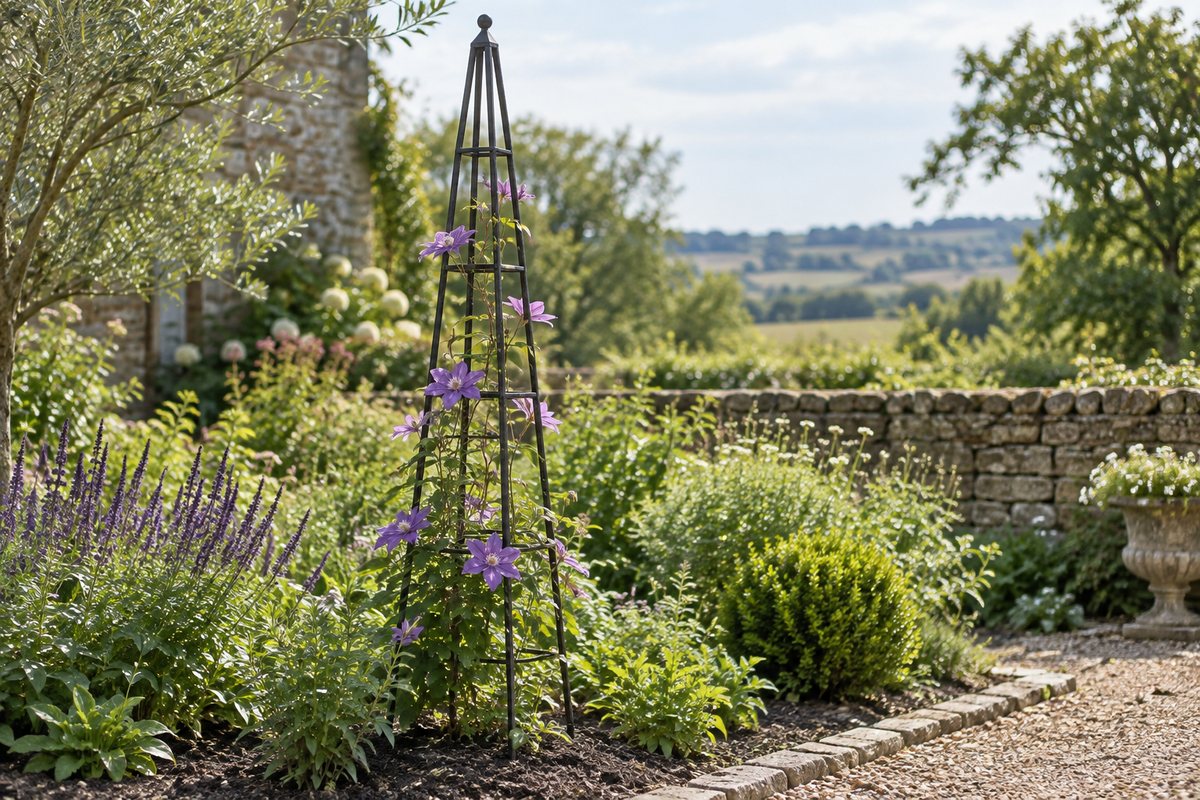
H Potter's Chic Farming Obelisk GAR470 is a tall, narrow garden structure: its listing gives 101 inches overall, a 12-inch inner square and roughly 16 inches across the outer feet. It also lists four 16-inch ground spikes. Those dimensions make it tempting when a gardener wants height without a wide base. The missing question is whether its reachable members and installation suit the named vine and the actual site.
We recommend treating GAR470 as a candidate for a vertical focal point, not a proven clematis or rose support. The maker page reviewed September 27, 2026 contains conflicting weight figures—31 and 331 pounds—so we omit weight as a fact.
Decide whether height solves your garden problem
At just over eight feet overall, GAR470 is taller on paper than the six-foot installed Essex examples in our freestanding comparison. But its overall height does not tell us the final visible height after the spikes are placed, and a taller frame is not automatically more useful. Confirm the plant's expected mature size and the finished position before deciding that height is the reason to choose it.
Imagine a compact clematis in a small border. A tall frame may dominate the space while the plant occupies only its lower portion. Another plant may need more width rather than more height. Now imagine a narrow bed where you specifically want an upright visual marker. GAR470's listed inner and outer widths may help lay out the frame, but foliage and working room will extend beyond those bare dimensions.
Mark a sixteen-inch span on the soil and then walk around it. Can you reach all sides to guide new growth and prune? Will it crowd a path or a neighboring plant? The frame's small footprint can be a genuine layout advantage in an open bed; it becomes less useful if squeezed against a wall where half its sides cannot be tended.
A tall structure in a container is a different arrangement. The listing's ground spikes are not proof that it can be installed safely in a particular pot. Do not infer container suitability from a styled photograph. Evaluate the pot, frame connection and exposed location together, or choose a documented container-specific design.
Separate the vine's climbing method from the frame's silhouette
For vining clematis, Illinois Extension explains why narrow graspable parts matter. The GAR470 listing does not give us the diameter or width of every member a leaf petiole would reach. A tall scroll or obelisk shape is not enough to establish a continuous climbing route. Ask for member dimensions or inspect the exact product before using it as a clematis choice.
Trace from the planting point to the first reachable bar, then upward through the structure. Are the gaps between members manageable for new growth? Would a narrow added layer be needed, and can it be attached under the maker's instructions? If you cannot answer those questions, a simpler wire or lattice support with known geometry may be more reliable for the plant's attachment method.
For a climbing rose, the issue changes. UConn explains that canes need guiding and ties. GAR470 could offer a vertical route to investigate, but a narrow inner square may give limited room to spread a vigorous rose. Check the rose's named variety and whether you can reach the proposed tie points after growth fills the frame. An arch or broad fence can be a better form when horizontal training is the goal.
| Published item | Useful for | Limit |
|---|---|---|
| 101 in overall height | Comparing visual scale | Installed visible height not established here |
| 12 in inner square; about 16 in across outer feet | Placing the bare frame on a plan | Not the full space needed for plant and gardener |
| Four 16 in ground spikes | Understanding the stated ground method | No guarantee for a particular soil, wind or plant load |
| Conflicting weight entries | Reason to ask the maker for clarification | Neither figure is used as a verified fact |
Check the site and assembly method
The listed spikes imply a ground installation, but soil and exposure vary. Read the current instructions for GAR470 and ask the maker what they intend for your conditions if the listing is incomplete. A heavy-looking metal form is not a structural rating. Nor does a long spike automatically solve a loose-soil or windy-site problem.
Plan installation before planting where possible. Placing a tall frame around an established vine can disturb roots and make assembly awkward. If the plant is already present, identify where the spikes would enter and how you would work around existing stems. If there is no clear route that protects the planting, consider a different support position or form.
Keep the top within a realistic care plan. Even when you can reach the lower bars, the upper portion may require a different approach to guide or remove growth. The listing's height can be an advantage for a plant that truly needs a taller structure, but it also adds maintenance reach. Do not buy extra height without deciding how you will use and tend it.
Choose another form when width matters more
A sound fence with narrow wire or lattice can give clematis more horizontal route than this compact obelisk. A wall panel can cover a planned vertical area, provided the wall and fixings are suitable. For roses, an arch or broad fence may give more room to arrange canes. These alternatives are not automatic winners; they simply solve different spatial problems.
Compared with the Essex Round, GAR470 gives a taller listed silhouette but less published information about graspable members. Essex Round lists one ⅜-inch tube dimension and an approximate installed height. Neither product has been tested here, and neither can be declared a universal clematis choice. The right next step is to resolve GAR470's missing member geometry and weight conflict with the maker if its form otherwise suits the site.
We also have no verified Amazon match for the exact GAR470 variant. Do not treat a similarly named listing as the same product. The maker page cited below supports published specifications; this review has no purchase link until the exact Amazon variant is verified.
Use the tall frame for a specific reason
- Confirm the plant's identity and expected scale before choosing a tall obelisk.
- Mark the listed frame footprint plus working and growth space in the bed.
- Ask for complete member dimensions if the plant is a leaf-petiole climber.
- Plan reachable tie points if the plant is a climbing rose.
- Read the exact ground instructions and assess soil and exposure.
- Ask H Potter to resolve the conflicting weight entries before relying on a weight figure.
We recommend investigating GAR470 when a tall, narrow freestanding form is the desired garden feature and the site can accommodate its installation and upkeep. Its published footprint and spikes help start that assessment. The unresolved member geometry, installed height and contradictory weight prevent a stronger product verdict. A lower or wider support may be the better answer when the plant, not the frame, sets the shape.